

 +91 8423662366
 Apply Now
Full Stack Engineering with DevOps
Validate AI-assisted code and build reliable applications.
AI adoption among software development professionals reached 90% in 2025, a 14% increase from the previous year. Source: Google Cloud, 2025 DORA Report


Duration

Application deadline


Type of program
AI is transforming industries and redefining job roles, making expertise in computer science with AI integration more critical than ever
From software development and cloud infrastructure to cybersecurity and data, AI is reshaping how systems are designed, built, deployed and secured. But using AI is only one part of the equation. Building dependable systems requires the ability to understand what lies beneath them, integrate intelligent capabilities and critically evaluate their outputs.
AI is no longer only a vertical discipline. It is changing how technology professionals across disciplines work.
As AI becomes a capability across computer science disciplines, professionals need more than familiarity with AI tools. They need strong computing fundamentals, domain expertise and the technical judgement to apply AI effectively, assess its limitations and build dependable systems.
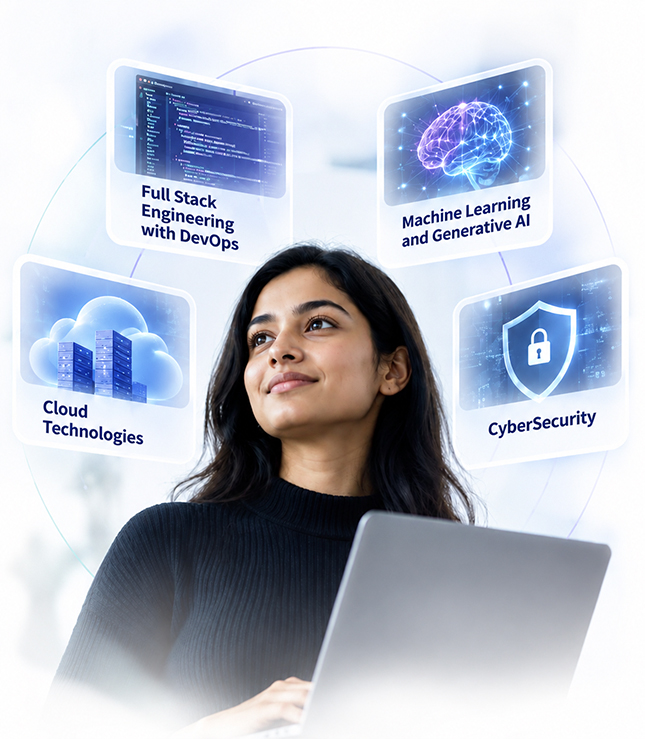
Build your foundation across programming, algorithms, systems, databases, networks, cloud and secure development, alongside machine learning and generative AI. Then choose from four optional specialisations or explore your interests through a broader selection of electives.

Full Stack Engineering with DevOps

Machine Learning and Generative AI

Cloud Technologies

CyberSecurity
As AI transforms what technology can do, build the computer science expertise and practical AI skills to design, develop and improve intelligent solutions.
Technology professionals need more than familiarity with AI tools. They need to validate AI-assisted code, operate AI workloads and secure intelligent systems.
India’s demand for AI talent could substantially exceed supply by 2027. Bain & Company projects more than 2.3 million AI job openings against an available talent pool of around 1.2 million—highlighting an opportunity to reskill over one million workers. The challenge extends beyond recruitment: 44% of executives surveyed identify insufficient in-house AI expertise as a major barrier.— Bain & Company, March 2025
The program brings these connected capabilities together through a common core and four optional specialisations:
Learning extends beyond concepts into implementation through assignments, course projects, Advanced Apex Projects and an industry-designed and vetted capstone. Working prototypes, analyses and technical reports - with testing and justified design decisions, help demonstrate your ability to apply what you learn.
Build the foundations. Choose your depth. Learn to think beyond the tool.
Build on your foundation in computer science and AI with advanced study in an area that matches your interests and career goals.
Across every specialisation, you’ll connect theory with implementation, evaluate technical choices and understand how AI intersects with your field.
Develop the skills to take an application from design and development through secure delivery and ongoing operation. Your core study brings together full stack application development, microservices, secure DevOps, monitoring and observability. You’ll explore both embedding AI features in applications and using AI within engineering workflows. Electives deepen your understanding of software testing, frontend engineering, API integration, release strategies, identity management, human–computer interaction and application reliability.
Evolve from building and deploying applications to engineering AI-enabled software and intelligent development workflows.
Study the models and methods behind intelligent systems, with core courses in deep neural networks, reinforcement learning, natural language processing and large language models. You’ll connect model development with the software, data and infrastructure needed to build usable AI applications. Electives offer deeper study in computer vision, time series, graph neural networks, federated learning, multimodal analytics, advanced LLMs, trustworthy AI, model optimisation, MLOps and AIOps.
Deepen your existing AI and ML expertise to design, develop, evaluate and deploy more advanced intelligent systems and generative AI applications.
Explore the architectural and engineering decisions behind cloud services, from deploying applications to keeping distributed systems dependable. Your core study covers cloud architecture, containers and Kubernetes, infrastructure as code, automation and reliability engineering. You’ll examine how these technologies support demanding workloads, including AI applications. Electives extend your learning into serverless computing, advanced networking, platform engineering, cloud security, AI-assisted operations, cloud economics and sustainable computing.
Advance from managing cloud infrastructure to architecting, deploying and operating cloud platforms that support AI-driven applications and workloads.
Develop a deeper understanding of how computing systems are protected—and how they can be compromised. Your core study covers cryptography, secure communication, network security, ethical hacking, penetration testing and AI security. You’ll examine AI both as a tool for security analysis and as a source of new vulnerabilities. Electives offer further exploration of threat hunting, security operations, incident response, digital forensics, identity and access management, and cloud security.
Strengthen your security expertise to address AI-driven threats, secure intelligent systems and apply AI-enabled approaches to threat detection and response.
You can choose not to specialise and select electives across disciplines, subject to prerequisites and program requirements. This pathway lets you explore different interests and build breadth across computer science and AI, with the option to undertake a capstone project.
Expertise: Agentic AI for Education | Big Data Analytics | Human-Computer Interaction | AI/ML Applications
Expertise: Generative AI | Large Language Models | Agentic AI
Expertise: Computer Science Education | Data Engineering | Distributed Systems | Cloud Computing | Machine Learning | AI in Education
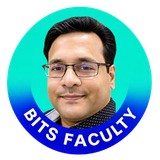
Expertise: Cloud-native AI | Agentic AI Systems | AI Engineering/MLOps | Secure & Sustainable AI
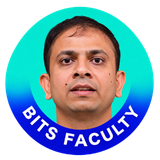
Expertise: AI Security | Adversarial Machine Learning | Malware Analysis | Network Security
Build your skills through projects of increasing complexity. From course assignments to advanced projects and a final capstone, applying your learning to real-world Industry problems.

Apply knowledge across multiple courses through two required Advanced Apex Projects. Identify a problem, choose the right approach, implement a solution and evaluate its outcomes. Strengthen your ability to integrate concepts, use AI where relevant and solve complex computing challenges.

Take your learning further through additional Advanced Lab and Design Projects. Experiment with contemporary technologies, explore technical approaches and develop system designs. Build practical experience through hands-on implementation and problem-solving.

In your final trimester, undertake a 12-unit, industry-designed and vetted Capstone Project. Work on real-world problems with realistic industry requirements and constraints. Take your solution from problem formulation and design to implementation, testing and evaluation, culminating in a demonstrable project.

Build in-demand skills by working on industry grade projects that companies work on

Learn from BITS professors and Industry Practitioners who have shaped changemakers for decades

Earn a degree that is widely respected and recognized across industries and geographies
Explore
When pursuing M.Sc. in Computer Science and AI, you won’t be just solving textbook problems—you’ll work on live industry-grade projects developed in partnership with BITS Pilani’s collaborators. These projects take place in a sandbox environment simulating real-world data pipelines and workflows.


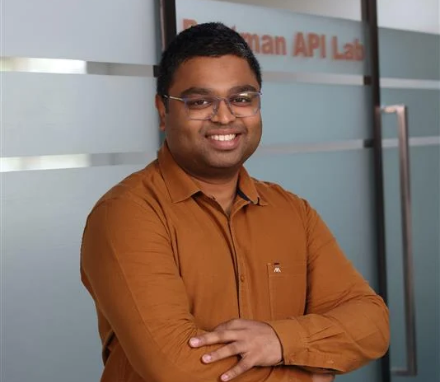
In this program, you won’t just learn from textbooks—you’ll learn from the people who’ve helped write the playbook on Computer Science and AI.
Rooted in BITS Pilani's long-standing tradition of academic excellence, this program is taught by experienced BITS faculty along with seasoned industry practitioners. Your learning journey will be guided by experts who bring a rich blend of academic insight and real-world industry experience.

Imagine getting access to the same tools Computer Science and AI experts use. From modern computing systems to intelligent AI applications, you’ll get hands-on knowledge and build things for real! By the time you graduate, you’ll not only understand the theory but also have an edge because of your experience using these tools.


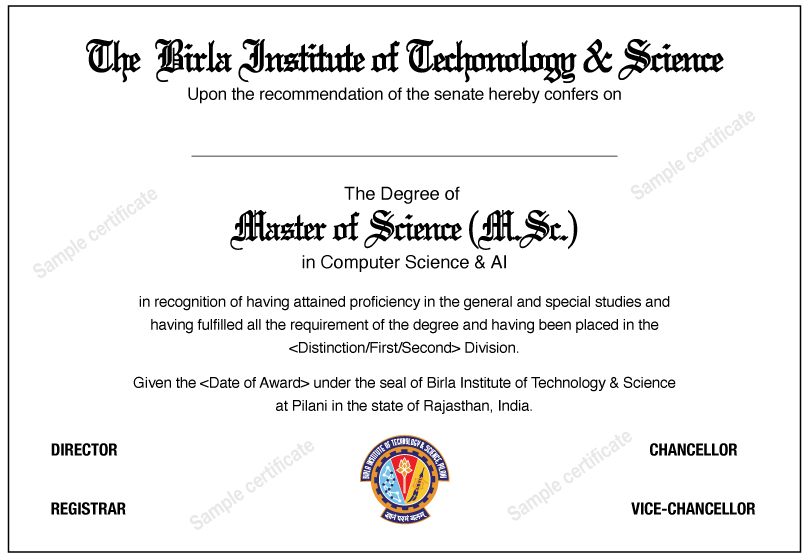
Earn a degree that’s trusted by employers, respected by universities, and built for your future.
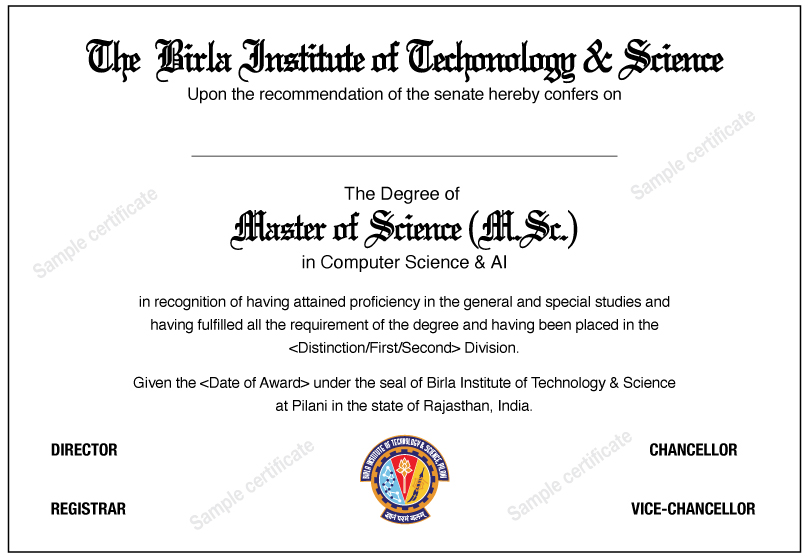
When you postgraduate from BITS Pilani Digital, you’re not just gaining skills—you’re earning a M.Sc. degree from one of India’s most respected institutions. This isn’t a certificate or a short-term course. It’s a full university degree that’s awarded by BITS Pilani, an Institution of Eminence.
Whether you’re applying for jobs, thinking about further studies, or planning to work abroad, your degree will speak for itself. It carries the weight and credibility of the BITS Pilani name—something employers trust and value, both in India and around the world.
The opposite side of the degree certificate will also mention Mode of Delivery, Date of admission and Date of completion.

Take learning beyond lessons with engaging workshops, real-world challenges and more!
Explore
Learning here goes beyond pre-recorded videos. Every weekend, you’ll join live sessions led by expert faculty.
Explore
Want a taste of campus life? You can join us for an optional campus immersion held once a year!
Explore
This is where your learning gets real. At BITS Pilani Digital, co-curricular activities are the core to how you grow as a Computer Science and AI professional. We will ensure that from your very first trimester, you’ll get into tackling real-world problems, or competing in hackathons, that make sure you're growing through action, and having fun while you do it.

Our Computer Science and AI faculty aren’t just academic and industry experts, they’re also friendly mentors who have got your back. Whether it’s clearing a concept or guiding a project, they’re always there for you, ready to help you push boundaries and reach your potential.

Learning is better together. That’s why we’ve built an active, welcoming community where you can ask questions, share ideas, and celebrate wins, big or small, with people who understand it.

Every weekend live sessions are organised for each course during which students get an opportunity to interact with faculty, clarify their doubts and further add to their learning.


As part of the BITS Pilani Digital experience, students will have the opportunity to participate in an optional campus immersion held once a year at one of the BITS Pilani campuses in India.
This 3-day immersive event is designed to offer students a chance to:
Participation in the campus immersion is completely optional, and students who choose to attend will need to bear the cost of travel and accommodation.

Missed the campus life? Don’t worry! Digital or otherwise, you’ll experience the campus vibes from optional lab access to special on-campus events, we give you opportunities to engage, explore, and feel that BITS energy up close.


Employers seek problem-solvers with proven expertise and PROPEL (Professional Excellence Portfolio) helps you demonstrate exactly that. It enables you to build an industry-ready portfolio, a strong personal brand, and a competitive career edge. Through the PROPEL Work Portfolio, you can showcase your real-world expertise through projects, industry exposure and experience, and professional growth, helping you stand out to employers as a job-ready Computer Science & AI professional.


At BITS Pilani Digital, your career journey is an ongoing process that equips you to grow with confidence, seize opportunities, and build a future you are proud of. With early exploration, hands-on experience, and focused guidance, we help you discover your strengths, build industry connections, and prepare for roles that match your goals and potential.
Toward the final phase of your program, you’ll receive placement support through structured platforms, employer connects, and access to career opportunities. While placements aren't guaranteed, BITS Pilani’s strong reputation, industry ties, and career support are here to help you take confident steps toward a rewarding future.

Your career journey begins right from year one. In the Online B.S. in Data Science & AI, you’ll take part in guided career awareness activities designed to help you explore paths that match your skills, interests, and dreams. Through sessions, workshops, and curated resources, you'll discover possibilities — from data science and AI research to product development and entrepreneurship.

As you move through the program, the focus shifts from exploring options to preparing for them. You'll get more tailored guidance to align your strengths with industry needs, find roles that fit you best, and prepare with clarity and confidence.

Toward the end of your journey, you’ll receive placement support through structured platforms, employer connects, and access to career opportunities. While placements aren't guaranteed, BITS Pilani’s strong reputation, industry ties, and career support are here to help you take confident steps toward a rewarding future.
Disclaimer: Placement assistance services offered through the IGNITE Cell at BITS Pilani Digital are designed to support and enable learners in their career development. However, BITS Pilani Digital does not guarantee job placement, internship offers, employer shortlisting, or any specific compensation outcomes. Final career outcomes depend on various factors, including individual performance, market conditions, and employer selection processes.

The world of Computer Science and Artificial Intelligence is evolving at an unprecedented pace, but your learning doesn’t have to follow a fixed schedule. With the M.Sc. in Computer Science and Artificial Intelligence, you get the flexibility to study your way, at your pace, while building depth across computing and AI.


At BITS Pilani Digital, AI isn’t limited to a single specialisation, it is a capability integrated across all five pathways. Each specialisation builds advanced expertise in a distinct area of Computer Science while exploring how AI can be applied, deployed, secured and evaluated within that domain.
Whether you want to secure intelligent systems, build AI-ready cloud infrastructure, develop smarter applications, specialise in machine learning or create dependable data foundations, you can choose a pathway aligned with your interests and career goals.

Join a powerful network of BITSians making impact across industries, startups, and countries
Explore
When you join BITS Pilani Digital, you're not just enrolling in a program — you're joining a powerful network of BITSians making an impact across industries, startups, and countries. Wherever you go, you’ll find a fellow BITSian not too far away.

If you’re passionate about Computer Science and AI, we’re here to make world-class learning accessible, no matter where you are
Explore

At BITS Pilani Digital, we deeply believe that talent, curiosity, and the desire to grow shouldn’t be held back by limited geography, work or study commitments or other such challenges. If you have the passion to learn Computer Science and AI — if you're ready to put in the effort and take bold steps toward your future — then you deserve the opportunity to do so. And we’re here to make sure that opportunity is within reach.
This program, like all our digital programs, is built with accessibility and inclusion at its core. It’s thoughtfully designed to break down the barriers that stand in the way of higher education while delivering holistic and industry ready learning in Computer Science and AI that BITS Pilani is known for. Whether you’re living in a far away town, have limited access to traditional campuses, switching paths from a non-technical background, or navigating other constraints — you’ll still find a place here at BITS Pilani Digital. Because we’re not just committed to education — we’re committed to empowering learners across India to rise, thrive, and build the futures they dream of.
This is where excellence becomes yours, with a learning journey that spans six trimesters of guided growth and self-driven discovery.
Year | Trimester 1 | Trimester 2 | Trimester 3 | |||
1 | ||||||
Course Title | Credits | Course Title | Credits | Course Title | Credits | |
Mathematical Foundations for Computing | 3 | Object-Oriented Programming & Design | 3 | Computer Networks | 3 | |
Programming and Data Structure | 3 | Algorithm Design & Problem Solving | 3 | Cloud Services and Platforms | 3 | |
Operating Systems | 3 | Machine Learning | 3 | Secure Software Development Practices | 3 | |
Computer Organisation and Architecture | 3 | Relational & Modern Databases | 3 | Generative AI Applications | 3 | |
Advanced Apex Project I | 2 | |||||
| Total | 12 | Total | 12 | Total | 14 | |
Year | Trimester 4 | Trimester 5 | Trimester 6 | |||
2 | ||||||
Course Title | Credits | Course Title | Credits | Course Title | Credits | |
Elective 1 | 3 | Capstone Project | 3 | Four Electives | 12 | |
Elective 2 | 3 | 3 | ||||
Elective 3 | 3 | 3 | ||||
Elective 4 | 3 |
| 3 | |||
Advanced Apex Project II | 2 | Advanced Apex Project III (Optional) | 3 | |||
| Total | 14 | Total | 12 | Total | 12 | |
A specialisation requires at least 18 units of coursework from its stipulated core and elective pool. Four core courses and two electives (to be picked up from a specialisation elective pool) are specified for each specialisation; all specialisation courses count against electives. Students may choose between no specialisation or one specialisation. Learners who opt not to pursue a specialisation are free to select electives across any domain rather than remaining confined to a specific track, thereby fostering a broader foundation of knowledge.
The second-year course structure and pathways are set out below. All students continue to complete the required Advanced Apex Projects in accordance with the programme structure.
| Pathway | Second-year coursework and project requirements |
|---|---|
| With a specialisation | Four specialisation core courses (12 units), two specialisation electives (6 units), two discipline electives (6 units), and a capstone project (12 units) |
| Without a specialisation | Eight electives (24 units) and a capstone project (12 units) |
Note: A course from any specialisation core or elective pool may be taken as a discipline elective if the student meets its prerequisites.
Click here for the detailed list of Directory of courses
Experience a unique trimester-based learning model where each week is carefully structured to maximize your grasp of concepts — while giving you the flexibility to learn at your own pace.

At the beginning of each week, access high-quality videos and engaging digital materials designed by faculty and industry experts through our Digital Learning Platform.

Post questions anytime to our dedicated academic helpdesk and receive timely responses from experienced teaching assistants.

Conclude your weekly cycle with live, discussion-rich online classes. These are conducted mostly on Fridays, Saturdays, or Sundays and help deepen your understanding while clarifying doubts through real-time, two-way interaction.

For lab-oriented courses, gain practical skills using secure and intuitive virtual or remote labs accessible from anywhere.
To fully benefit from the program, students are expected to invest 5 to 7 hours per course per week in a trimester- covering video lectures, coursework, and live sessions.
For a typical trimester with 4 courses, this amounts to 20 to 30 hours of learning per week. We recommend allocating 3 to 4 hours of learning time per day to stay on track and maximize your outcomes.
Disclaimer: These are indicative learning hours. Actual time required may vary by course depending on complexity, prior background, and learning pace.
This structured-yet-flexible approach empowers you to balance your professional and personal commitments without compromising on academic rigor or engagement
Applicants must hold a 3-year or 4-year Bachelor's Degree with Mathematics or Statistics as a subject, with a minimum of 60% overall marks.
Recognising the value of professional experience, BITS Pilani Digital offers additional eligibility flexibility for applicants with relevant work experience:
Applicants who meet the standard academic eligibility criteria do not need to fulfil any minimum work experience requirement.
Applicants who have not studied Mathematics or Statistics as part of their Bachelor's Degree may be considered if they have concurrent enrolment in a STEM program (PG in science or engineering with Math).
Applicants should have passed a 3-year (or a 4-year) college degree (STEM) offered by an accredited University /recognised by the country of residence of the applicant, with Math/Stat as a subject, and an overall CGPA of 6.0 or above, or overall marks of 60% or above. An equivalence certificate issued by AIU, UGC or an equivalent statutory body of India is accepted.
Applicants who have not studied Mathematics or Statistics as part of their Bachelor's Degree may be considered if they have concurrent enrolment in a STEM program (PG in science or engineering with Math).
Disclaimer: BITS Pilani maintains full authority to determine whether an applicant's professional background qualifies as relevant experience.
0%
EMI available
1st trimester (includes admission fee)
Instalment of INR 18,333 p.m.
2nd trimester onwards
Instalment of INR 12,833 p.m.
| Year | Qualification earned | Trimesters | Fee per trimester | Total trimester fees for year | Cumulative trimester fees |
|---|---|---|---|---|---|
| Year 1 | Trimester 1, 2, 3 | INR 38,500 | INR 38,500 x 3 = INR 1,15,500 | INR 1,15,500 | |
| Year 2 | M.Sc. in Computer Science & AI | Trimester 4, 5, 6 | INR 38,500 | INR 38,500 x 3 = INR 1,15,500 | INR 2,31,000 |
| Year | Qualification Eearned | Trimesters | Fee per Trimester | Total Trimester Fees for Year | Cumulative Trimester Fees |
|---|---|---|---|---|---|
| Year 1 | - | Trimester 1, 2, 3 | USD 495 | USD 495 x 3 = USD 1,485 | USD 1,485 |
| Year 2 | M.Sc. in Computer Science & AI | Trimester 4, 5, 6 | USD 495 | USD 495 x 3 = USD 1,485 | USD 2,970 |
| Year | Qualification Eearned | Trimesters | Fee per Trimester | Total Trimester Fees for Year | Cumulative Trimester Fees |
|---|---|---|---|---|---|
| Year 1 | - | Trimester 1, 2, 3 | USD 743 | USD 743 x 3 = USD 2,229 | USD 2,229 |
| Year 2 | M.Sc. in Computer Science & AI | Trimester 4, 5, 6 | USD 743 | USD 743 x 3 = USD 2,229 | USD 4,458 |

Fee payment by easy-EMIs with 0% interest. Click here to learn more.
Click here for more information on Propelld process.
At the end of every course in the trimester, students are required to appear for a trimester end exams to demonstrate their learning. The mode of examination is determined by the student's country of residence.

Students residing in India will take their exams in person at one of BITS Pilani’s officially designated examination centres.
Choose from 22 centres spread across major cities in four zones:
South zone – Bangalore, Chennai, Hyderabad, Thiruvananthapuram, Vijayawada
North zone – Chandigarh, Dehradun, Delhi NCR, Jaipur, Jammu, Lucknow, Pilani
West zone – Ahmedabad, Goa, Mumbai, Nagpur, Pune
East zone – Bhubaneswar, Guwahati, Jamshedpur, Kolkata, Patna
Students may update their preferred exam centre each trimester, subject to availability.
Note-:
The University reserves the right to change, add, remove, or reallocate examination centres/cities based on administrative, operational, or student participation requirements.

Students residing outside India will take their exams in an online proctored format from their country of residence.
All requirements and technical guidelines will be shared in advance to ensure readiness.


The program helps you understand how AI connects with the computing systems you already build, support or operate. Alongside Machine Learning and Generative AI, you study programming, algorithms, databases, operating systems, networks, cloud and secure development.
For example, a developer needs to evaluate AI-generated code and integrate intelligent features securely. A cloud professional needs to understand deployment, monitoring and infrastructure for AI workloads. The program develops these connections through coursework and practical implementation.
Its value is in strengthening your ability to make sound technical decisions as your work evolves. No degree can guarantee protection from changes in employment.
Your existing education and experience provide a starting point. The useful question is where you now need greater depth or a wider understanding of systems.
You may already develop applications but want stronger capabilities in architecture, secure delivery and observability. You may manage infrastructure but want to understand distributed systems and AI workloads more deeply.
Some foundation topics may be familiar. The program’s potential value lies in connecting them with advanced coursework, AI applications and integrated projects.
You can build on your current field. AI is a common capability across the program, while the four optional specialisations support different directions:
All learners in the year 1 itself will study a course in Machine Learning and a course Generative AI Applications. You may choose one specialisation or take a broader elective pathway. Your choice should reflect the work you want to do, rather than the popularity of a title.
The program combines conceptual study with laboratories, assignments and practical implementation. It includes two required Advanced Apex Projects that integrate learning across courses, followed by a substantial industry-designed and vetted Capstone.
Depending on the course and pathway, practical work can involve application development, infrastructure automation, security assessment, model evaluation or monitoring deployed services.
The emphasis includes explaining design choices, testing results and understanding limitations. This can help you connect learning with professional problems. Actual assignments follow academic requirements, and applying learning to an employer’s systems requires the appropriate permissions.
A focused certificate or independent learning may suit a specific immediate requirement. This MSc addresses a wider goal: developing a connected understanding of computing systems, AI and advanced technical practice.
For example, learning to use an AI coding assistant differs from understanding whether its output is secure, maintainable and appropriate for a distributed application. That judgement draws on software design, algorithms, databases, infrastructure and testing.
Choose the MSc if you want sustained academic depth, structured assessment and substantial integrated project work. If your requirement is limited to few tools and technologies, compare a focused option before committing.
The program’s learning format is designed to help you balance study with work and personal responsibilities. Recorded learning content can be accessed at a time that suits you within each weekly learning cycle and revisited later for revision. Live interactive sessions take place on weekends, helping you plan your participation around weekday commitments.
This gives you room to organise your learning around delivery deadlines, on-call duties and family time. A regular study routine, supported by planning ahead for assignments and projects, can make the commitment more manageable.
At the same time, this is a rigorous postgraduate program. While the format is flexible, learners must complete assessments and achieve defined academic milestones within scheduled timelines. You should also plan for mandatory offline trimester-end examinations in India, held on weekends.
Being away from formal study for a few years does not mean you cannot return to learning effectively. Your professional experience brings practical context, problem-solving skills and discipline that can support your academic journey. With focus, consistent effort and a regular study routine, you can rebuild confidence and gradually settle into being a student again.
One of the early core courses, Mathematical Foundations for Computing, helps establish the mathematical grounding needed for more advanced courses. Alongside Programming and Data Structures, it provides an opportunity to strengthen essential foundations.
You can also ease back into learning by using open resources to refresh familiar mathematics and programming concepts. You do not need to remember everything at the outset; regular practice can help you regain confidence as you progress.
The program will require sustained effort, but time away from the classroom need not hold you back. A planned approach and steady practice can help you make meaningful progress.
Depending on your pathway, illustrative evidence could include an application with secure APIs and a deployment pipeline, an automated cloud environment with reliability analysis, an authorised security assessment, or an AI application evaluated against defined criteria.
The program’s laboratories, Apex Projects and Capstone provide opportunities to develop this evidence. These examples describe possible outputs, rather than promised assignments.
For an experienced professional, the strongest discussion connects this work with responsibilities you already understand and the more demanding problems you want to handle.
The program can help you build on your existing experience and develop capabilities for more advanced technical roles, greater responsibility or a move into a new computing discipline. Its combination of Computer Science foundations, applied AI and optional specialisation offers opportunities to strengthen both your technical depth and your understanding of complete systems.
Through practical assignments, Advanced Apex Projects and the Capstone, you can develop demonstrable work to support conversations with your manager or prospective employers. This can help you present a stronger case for taking on complex projects, expanding your responsibilities or pursuing new opportunities.
To judge the return on your investment, consider the capabilities you want to gain, the opportunities you want to pursue, and how the program’s curriculum aligns with those ambitions, alongside the fee and study commitment.
A degree does not guarantee a job change, promotion or salary increase. Those outcomes depend on your experience, performance, opportunities and employer requirements.
Both programs offer valuable pathways into AI-related work. The right choice depends on the capabilities you want to develop and the kinds of problems you enjoy solving.
The M.Sc. in Computer Science and AI is a good fit if your interests centre on understanding data, applying statistical methods, developing predictive models and using AI to generate insights and intelligent solutions.
The M.Sc. in Computer Science and AI is a good fit if you want to design, build, secure and operate computing systems, with AI integrated across these activities. It combines computing foundations with opportunities to specialise in CyberSecurity, Cloud Technologies, Full Stack Engineering with DevOps, or Machine Learning and Generative AI.
For example, in an AI-enabled banking application, a data science professional might focus on developing and evaluating a fraud-detection model, while a computing-systems professional might focus on integrating it securely into a reliable application. These responsibilities overlap, and both programs can support AI-related ambitions.
Yes. On successfully completing the program’s academic requirements, you will receive the M.Sc. in Computer Science and Artificial Intelligence from BITS Pilani, offered through BITS Pilani Digital.
The Ministry of Education, Government of India, granted BITS Pilani Institution of Eminence (IoE) Deemed to be University status through its notification dated 14 October 2020.
As an Institution of Eminence, BITS Pilani is empowered to offer programs through online mode under the applicable regulatory framework, subject to the minimum standards prescribed by the UGC. bits-pilani.ac.in
You can verify these provisions in the official BITS Pilani notice on regulatory provisions for online education, which includes the supporting notifications and regulations.
For Indian applicants, eligibility is not restricted to Computer Science or engineering graduates. The standard requirement is a three-year or four-year bachelor’s degree with Mathematics or Statistics as a subject and at least 60% overall marks.
This allows applicants from different academic backgrounds to be considered, provided they meet the requirements. Work experience is not mandatory under the standard route.
Your degree, marks and subject coverage will be verified during the admission process. If you are unsure whether a subject on your transcript meets the Mathematics or Statistics requirement, share the details with Admissions for clarification.
Yes, the program provides experience-based concessions in the minimum overall marks requirement for eligible Indian applicants:
These provisions recognise the experience professionals develop through their careers. BITS Pilani determines whether an applicant’s experience qualifies as relevant.
The remaining educational requirements, including the Mathematics or Statistics requirement or its prescribed alternative, continue to apply. Share your academic and professional details so that your application can be assessed against the appropriate route.
The program specifies an alternative through concurrent enrolment in a STEM postgraduate program in science or engineering that includes Mathematics.
If this applies to you, share the program details, enrolment evidence and relevant Mathematics coursework with Admissions for evaluation. The team can clarify the supporting information required for your case.
Refreshing mathematics through open resources can help you prepare academically, but it does not by itself replace the formal subject requirement. Establishing the applicable eligibility route before proceeding will help you make an informed application.
Begin through the official BITS Pilani Digital application portal. Select M.Sc. in Computer Science and Artificial Intelligence, complete the required information and follow the program-specific instructions for documents, submission and payment.
Keep your academic records available so that your degree, overall result and Mathematics or Statistics coursework can be verified. If you are seeking an experience-based marks concession, also keep supporting information about your professional experience ready.
Use the checklist displayed for your application as the final guide to required documents. Review the program selection and information carefully before submitting. The official website directs degree applicants to this application portal.
You can return to the application portal using your registered login to resume your saved application and review any pending steps.
For a document-upload issue, check the permitted file format and size, and ensure the document is clear and readable. If the problem continues, email Admissions([email protected]) with your application number, registered email address, a screenshot of the error and the relevant document.
For a payment issue, share the transaction reference and payment confirmation, where available, and seek clarification before making another payment. Keep passwords, OTPs and complete card details private. Official contact details are available on the Contact Us page.
Recorded learning content is released on a weekly schedule, generally in shorter video segments. You can access it at a convenient time within that weekly learning cycle and revisit it later for revision. Weekend live sessions provide opportunities for interaction and clarification, with additional practical sessions where required.
This structure helps you organise learning around work and personal responsibilities while maintaining regular academic progress.
The program also includes quizzes, assignments and project work. These have defined requirements and deadlines, so you should plan to complete each learning cycle and its assessments on schedule. Flexibility supports your study routine while preserving academic rigour.
Academic learning is delivered online, while mandatory trimester-end examinations in India take place offline at designated examination centres.
The program provides for Trimester end examinations scheduled mostly on weekends typically Fridays, Saturdays and Sundays, with regular and makeup slot options. You should follow the examination schedule and instructions communicated for your cohort and plan any required travel or work arrangements in advance.
Assessment also takes place throughout the trimester through quizzes, assignments and projects. Completing the program therefore involves both regular participation in assessment activities and meeting the applicable examination requirements.
Applicants based outside India will have an option of Online proctored examinations on providing the proof of location as required by the institute.
You may choose one specialisation or a broader pathway without a specialisation.
A specialisation requires 18 units of coursework, comprising four specified core courses worth 12 units and two specialisation electives worth six units. These courses form part of the degree’s prescribed coursework rather than an additional qualification outside it.
The standard second-year plan also includes two discipline electives and the Capstone. Without a specialisation, the standard plan includes eight electives and the Capstone. Required Advanced Apex Projects remain part of both pathways.
Eligible courses from specialisation pools may also be taken as discipline electives when prerequisites are met.
You must successfully complete the prescribed courses, assessments and projects and meet the program’s 76-unit graduation requirement.
The standard program structure comprises:
| Component | Units |
| Common first-year coursework | 36 |
| Second-year coursework and electives | 24 |
| Required Advanced Apex Projects I and II | 4 |
| Capstone Project | 12 |
| Total | 76 |
The nominal duration is two years across six trimesters. Subject to academic rules, you may pursue a more relaxed pace through options such as part-time study and pause/resume, within a maximum of four years or 12 trimesters.
Graduation depends on successful academic completion, including the applicable course, credit and assessment requirements.
There is no entrance test for admission to this program. It welcomes eligible working professionals looking to deepen their expertise or pursue new career directions, as well as fresh graduates seeking to build advanced computing capabilities.
Admission is based on meeting the prescribed eligibility requirements and verification of your academic qualifications, overall marks and Mathematics or Statistics coursework. If you are applying through an experience-based marks concession, BITS Pilani will also assess the relevance of your professional experience. Work experience is not mandatory for applicants meeting the standard eligibility criteria.
The program maintains rigorous academic standards through coursework, practical assignments, projects and examinations. Whether you are returning to education after several years or continuing from undergraduate study, successful completion requires consistent effort, active engagement and achievement of defined academic milestones.
Submit a complete application with the required supporting documents and respond promptly to any clarification requests. Following review, your admission decision and any applicable conditions will be communicated through official admission correspondence.
The program provides several ways to seek academic support. You can revisit recorded learning content, interact with faculty during weekend live classes, and use discussion forums and teaching-assistant support to clarify doubts about concepts, coding assignments and practical work. The Capstone also includes academic supervision.
Discussion forums allow you to post questions between scheduled sessions and learn from discussions with fellow learners. Questions are addressed within reasonable timeframes, so raising doubts early gives you time to work through the guidance before assessment deadlines.
If you find a topic difficult, revisit the relevant material, attempt the exercises and explain where you are getting stuck. Sharing your approach, code or error messages, where relevant, helps faculty and teaching assistants provide more focused guidance.
You are not expected to understand every concept immediately. Regular practice, active participation and timely use of the available support can help you build confidence and make steady progress.
Before enrolling, review the approved CS & AI fee schedule alongside your intended study plan. Consider application and admission fees, tuition, examination travel and any separately payable learning resources.
The currently published degree policy requires the full trimester fee for each registered trimester, irrespective of the number of courses. Taking fewer courses should therefore not be assumed to reduce that trimester’s fee.
An approved academic break currently attracts a continuity fee of ₹10,000 per trimester of absence, payable when you resume. Certain cloud or GPU usage beyond shared learning environments is also learner-funded. Confirm how these provisions apply to your CS & AI study plan before committing.
The mode of learning is online, with classes mostly scheduled on Fridays, Saturdays, and Sundays. The curriculum is thoughtfully designed to balance flexibility, structure, and academic excellence. All teaching, mentoring, lab work, and ongoing assessments are conducted through BITS Pilani’s advanced Digital Learning Platform, enabling you to learn from anywhere, at your own pace.
While the entire learning experience is delivered online, students residing in India are required to appear for end-of-trimester exams at officially designated BITS Pilani examination centres across major cities. This ensures the flexibility of digital learning while upholding the rigour and credibility of a BITS Pilani academic evaluation.
Yes — the M.Sc. in Computer Science & AI from BITS Pilani Digital is a formal postgraduate degree awarded by BITS Pilani, an Institution of Eminence. Also as per Clause 22 of the UGC (ODL & Online Programs) Regulations, 2020, degrees awarded by recognized institutions through online mode are considered equivalent to degrees offered through the conventional mode.
This means your degree will hold the same recognition as any other UGC-approved postgraduate degree and will generally be valid for pursuing higher studies, including PhD opportunities in India or abroad, subject to the specific eligibility criteria of the institution you apply to.
Additionally, the strong research orientation built into the program — through continuous project work, Apex Projects, and the final Capstone or Thesis — helps you develop the research skills and portfolio that many doctoral programs look for.
However, since PhD admission requirements can vary across universities and countries, it’s always advisable to check the exact criteria of your target institution, especially around credit requirements, research prerequisites, and any entrance exams or interviews they may conduct.
Yes, you can. The program is designed to offer flexibility that fits your pace and priorities. While there is a recommended number of courses per trimester to help you complete the degree on time, you are free to take fewer courses in any given trimester if you need to manage other academic, personal, or professional commitments. This allows you to customise your learning journey based on your capacity and goals. Whether you want to slow down during a particularly busy period or spread out your workload more comfortably, the structure of the program supports you in doing so without any academic penalty
Yes, absolutely. The program offers the flexibility to take a break for one or more trimesters if you need to pause your studies due to personal, academic, or professional reasons. This ensures that your progress is not lost, and you can return when you're ready.
That said, here are a few important things to note:
This structure allows you to manage your learning journey on your own terms, while ensuring a smooth and supported return to the program whenever you're ready to continue.
You are allowed a maximum of 4 years to complete the full 2-year M.Sc. Degree in Computer Science & AI. This generous timeframe is designed to give you the flexibility to balance your studies with other academic, professional, or personal commitments.
There are no additional fee implications for progressing at a slower pace. The program follows a trimester-based fee model — meaning the trimester fee remains the same regardless of the number of courses you choose to register for in that term. The only additional charge is a continuity fee, which applies only if you take a full break for one or more trimesters. This fee is paid at the time of resuming the program.
This flexible structure ensures that your learning stays aligned with your life, while still allowing you to earn a prestigious BITS Pilani credential — on your own terms and timeline.
As part of the BITS Pilani Digital experience, students will have the opportunity to participate in an optional campus immersion held once a year at one of the BITS Pilani campuses in India.
This 3-day immersive event is designed to offer students a chance to:
Participation in the campus immersion is completely optional, and students who choose to attend will need to bear the cost of travel and accommodation.
This annual event adds a touch of the BITS campus experience to your flexible online journey — offering a rich blend of learning, connection, and celebration.
Yes! As a student of BITS Pilani Digital, you are part of the larger BITS Pilani community and will have the opportunity to attend select festivals, cultural events, and academic gatherings held at BITS campuses across India.
BITS Pilani Digital will regularly share opportunities for students to participate in such events, allowing you to experience the vibrancy of campus life, connect with peers and faculty, and take part in memorable community experiences.
Participation is optional, and students will be responsible for their own travel and accommodation. It’s a wonderful way to enrich your educational journey with real-world connection, celebration, and belonging.
As a student of BITS Pilani Digital, you will have the opportunity to tap into BITS Pilani’s strong entrepreneurship ecosystem. You can unlock opportunities to build your tech startup from the ground up through a combination of industry-relevant curriculum, a diverse peer network, and access to incubation support via the Pilani Innovation & Entrepreneurship Development Society (PIEDS) — the official technology business incubator of BITS Pilani.
Whether you're just exploring an idea or ready to launch, this support ecosystem is designed to nurture innovation, guide early-stage ventures, and connect you to industry mentors, investors, and resources — empowering you to take your entrepreneurial journey forward with confidence.
As part of your learning journey, you’ll have access to:
In addition, we are building student communities and online clubs to enable collaboration, creativity, and shared interests across batches and backgrounds.
Through these activities, you’ll not only sharpen your skills but also build confidence, form meaningful connections, and experience the vibrant culture of the broader BITS Pilani community
Students enrolled in the M.Sc. in Computer Science and Artificial Intelligence at BITS Pilani Digital receive career and placement assistance through the IGNITE Career Support Cell.
The support helps working professionals prepare for career progression or new opportunities, while also helping fresh graduates build readiness for their first professional roles.
You can benefit from:
Placement-related support is particularly active during the final year, as learners prepare for their next career step. Your coursework and projects can provide evidence of technical capability to discuss with prospective employers.
Placement assistance does not guarantee a job, promotion, employer shortlisting or a particular salary. Outcomes depend on your experience, skills, individual performance, available opportunities and employer selection processes.
The aim is to equip you with the preparation, guidance and confidence to pursue opportunities aligned with your goals.
Some advanced courses or projects may require cloud or GPU resources beyond the shared or open-source learning environments provided.
Where additional infrastructure is required, such as AWS, Google Cloud or Microsoft Azure, the associated usage costs are borne by the learner and are not included in the program fee. These costs depend on the resources used and the requirements of the activity or project.
Details of any such requirements, along with estimated cost guidance, will be shared before the relevant module begins so that you can plan accordingly.


