
 +91 8423662366
 Apply Now

-

Program Fee
INR 16,520/ month
(Six-month interest-free EMI)

Batch starts
3rd October, 2026
Few Seats Left
Duration
~30 Weeks

Eligibility
2+ years of tech work experience

Type of program
Certificate
Program introduction
AI is moving from prompts to autonomous systems
Learn to build Agentic AI and RAG systems that can reason, retrieve, automate, and perform reliably in real-world environments.
Agentic AI is the next big shift. Gartner expects that by 2028, over half of enterprises will move beyond assistive AI and favor platforms built for workflow results. And Microsoft reports that 57% of Indian business leaders expect teams to build multi-agent systems to automate complex tasks. The shift is no longer about using AI to assist work. It is about designing AI systems that can execute it.
Why choose this program
Most Generative AI programs stop at concepts, prompts, or tool demos. This program goes further, helping you build real AI systems, not just experiment.
Master agentic AI, RAG, workflows, and evaluation for production-ready implementation.
Many AI courses treat Agentic AI as an add-on topic after covering basic GenAI and prompting. Learners may understand what an AI agent is, but they rarely learn how to design agentic systems that can plan, use tools, manage context, coordinate actions, and handle failure.
Learn deeper,
rise higher
as this program puts Agentic AI at the centre of the learning journey. You will learn how intelligent systems are structured, how agents reason, how tasks are decomposed, how tools are called, and how workflows are orchestrated for real-world use cases.
Passive lectures can create familiarity, but they rarely create capability. Many learners finish AI courses with theoretical understanding but struggle when asked to build, debug, or integrate an AI system independently.
Learn deeper,
rise higher
with practice-first learning model. In this program, concepts are translated into hands-on labs demonstrations, guided implementation, production-style demos, and real problem-solving exercises. You do not just learn how AI systems work, you build them.
In many program, the capstone is a short final assignment or a polished demo that does not reflect the complexity of real AI implementation. It may look good on paper but rarely proves end-to-end system-building ability.
Learn deeper,
rise higher
with an industry-aligned AI systems project. You will work through the complete journey of building a solution: identifying the problem, designing the architecture, building the RAG or agentic workflow, integrating tools, evaluating performance, and presenting a working outcome.
Traditional assessments test memory. But AI engineering is not about remembering definitions, it is about making systems work under constraints. Multiple-choice tests cannot measure whether someone can build a reliable AI application.
Learn deeper,
rise higher
as this program uses project-based evaluation to assess what truly matters: your ability to apply concepts, build working artifacts, solve technical problems, evaluate outputs, and improve system performance. Your progress is measured through execution, not just theory.
In most programs, concepts make sense in the classroom but fall apart in production, leaving a gap between academic learning and real-world execution.
Learn deeper,
rise higher
Apply your learning through a capstone project, with topics selected at the Institute's discretion and executed independently by each learner, helping you solve real-world challenges and build an industry-ready portfolio.
Most GenAI courses stop once the model generates an answer. But in production, that is only the beginning. AI systems must be tested for hallucinations, retrieval quality, consistency, safety, and failure modes before they can be trusted.
Learn deeper,
rise higher
with evaluation built into the learning experience as a core engineering skill. You will learn how to test and improve AI systems using evaluation frameworks, regression testing, retrieval checks, prompt quality assessment, and reliability-focused workflows.
Some program teach agent frameworks in isolation. Others teach workflow automation without deep AI reasoning. But real enterprise AI systems need both: intelligent agents that can reason, and workflow layers that can execute actions across tools.
Learn deeper,
rise higher
by learning how to connect agent orchestration with workflow orchestration. This includes working with AI agents, RAG systems, APIs, Model Context Protocol, Zapier style, Flask, Streamlit, and other layers required to move from intelligence to real-world action.
Disclaimer:
Tools may change on the go based on the assessment of BITS Pilani experts and module requirements.
Many program compete by listing dozens of tools. But tool overload often leads to shallow familiarity. Learners may recognize many logos but lack depth in how to choose, connect, and apply the right tools in an AI system.
Learn deeper,
rise higher
as this program focuses on tool depth across the AI systems stack. For each category, you work with carefully selected tools that are relevant for real implementation, from LLMs and RAG infrastructure to agent frameworks, workflow automation, application layers, and evaluation systems.
Knowing AI isn’t enough. You need the direction and confidence to put it to work in your career. That’s where our Career Services framework steps in which provides
Learn deeper,
rise higher
- Learn from industry experts: Gain insights from industry professionals who help you align your skills with real-world expectations.
- Curated Career Enablement: Access to opportunities through the BITS Pilani Digital’s career services ecosystem.
Disclaimer:
BITS Pilani Digital equips learners with industry-relevant skills and career support to enhance employability. However, job placement or advancement is not guaranteed. Opportunities depend on market conditions, learner performance, and individual goals. Learners are expected to take ownership of their career growth and actively apply what they learn.
What you will build
Across the program, you will work on hands-on labs applied projects, and a capstone designed to demonstrate real AI system-building capability.
You will build practical artifacts such as
Systems stack you’ll master
Learn how modern AI systems are architected across LLMs, RAG, agents, workflows, and evaluation layers.
Understand how each component connects to build systems that go beyond responses.
Create AI solutions that can reason, retrieve, act, and perform reliably in real-world environments.

Intelligence & Reasoning Layer
Where AI understands, reasons, and generates outputs
- OpenAI
- Anthropic
Use leading LLMs as the reasoning engine behind AI applications, agents, structured outputs, and intelligent workflows.

Agent Orchestration Layer
Where intelligence becomes multi-step execution
- CrewAI or equivalent
Design AI agents that can plan, divide tasks, use tools, coordinate roles, and execute complex workflows.

AI Application Layer
Where AI systems become usable products.
- Flask
- Streamlit
Build user-facing AI applications that turn LLM, RAG, and agent workflows into working proof-of-concept products.

Integration & Protocol Layer
Where AI connects with tools, context, and external systems
- Model Context Protocol (MCP)
Understand how modern AI systems standardise context sharing, tool access, and external actions.

Knowledge & Retrieval Layer
Where AI grounds itself in trusted data
- Qdrant
- PDFs
- Google Drive
Build RAG pipelines that retrieve relevant context, reduce hallucinations, and improve the reliability of AI-generated responses.

Workflow Automation Layer
Where AI moves from response generation to business execution
- Zapier or equivalent
Automate multi-step workflows across tools, approvals, notifications, and business processes.

Action Layer
Where AI agents interact with real work environments
Build AI systems that can send updates, trigger actions, support users, and operate within team communication workflows

Evaluation & Reliability Layer
Where AI systems are tested before they are trusted
- Pytest
- Evaluation Harnesses
- Regression Testing
- Hallucination Checks
Measure output quality, test retrieval performance, catch regressions, and improve AI system reliability before deployment.

From Tool Familiarity to AI Systems Thinking
Most AI programmes teach tools in isolation.
This programme teaches how they work together as a complete AI system:
LLMs → RAG → Agents → Applications → Workflows → Actions → Evaluation
You will not just learn what each tool does.
You will learn how to connect them into systems that solve real problems.

From Tools to Systems Thinking
Most programs teach tools in isolation
This program teaches how they work together as a system:
Intelligence → Retrieval → Reasoning → Action → Evaluation → Deployment
Note: To ensure depth over tool overload, the program focuses on carefully selected tools with strong industry relevance. Tool choices may be updated based on adoption, availability, and curriculum fit. Some labs may require learners to access third-party platforms. While several tools are free or open-source, select tools may involve additional subscription or usage-based costs.
Who should apply?
For professionals ready to move beyond AI experimentation and start building production-grade Agentic AI and RAG systems. It is built for professionals who want to work with LLMs, AI agents, RAG pipelines, Python, workflow automation, evaluation frameworks, and modern AI orchestration tools to solve practical technology and business problems.

Data, AI & software engineering professionals
For software engineers, AI/ML engineers, data engineers, backend developers, and solution architects who want to move beyond model experimentation into designing multi-agent systems, advanced RAG pipelines, and deployable AI services.

Product & technical leaders
For technical product managers, platform leads, engineering managers, and innovation heads responsible for bringing AI into products, platforms, and enterprise workflows.
Learn how Agentic AI systems are architected, evaluated, integrated, and governed — so you can lead AI initiatives with both technical confidence and business clarity.

Mid-career technology professionals
For professionals with prior exposure to programming, APIs, backend systems, data workflows, or software delivery who want to transition into high-impact AI roles.
This program helps you build the capabilities needed for Agentic AI engineering, RAG application development, AI solution architecture, and AI systems design.
Eligibility criteria
Applicants must possess a minimum bachelor's degree from a recognised degree and should have studied Maths in Grade 12. They should have a minimum 2 years of relevant work experience in areas such as software development , data, analytics , cloud , AI/ML, IT and other allied fields.
Learning methodology
The program follows a flipped-classroom model, combining flexible self-paced learning with structured live sessions.

Learn in a flipped classroom format
- The program follows a flipped-classroom methodology, where learners first build conceptual understanding through self-paced learning material.
- Wherever applicable, they complete practice exercises and labs to apply these concepts before attending periodic live sessions scheduled mostly on weekends.
- The live sessions are designed for instructor interaction, doubt resolution, deeper discussion, and augmented learning.

Apply learning to real-world AI challenges
- Learners engage with a range of real-world AI challenges throughout the program, connecting conceptual learning with hands-on application.
- The program is designed to help learners translate classroom knowledge into practical industry-relevant solutions through exercises, lab demonstrations, and project-based work.

Weekly learning rhythm
- Learner effort is expected to be typically 9–10 hours per week engaging with the program, including self-paced learning material, demos, lab practice, and live sessions.
- The mix of learning components may vary from week to week based on the requirements of each module.
- Note that the periodic live sessions are for ~2 hours, and the remaining learner effort is required to consume self-paced materials, demos, and lab practice.

Weekly live instructor interactions
- Learners attend weekly live sessions of ~2 hours, mostly on weekends.
- These sessions are led by subject matter experts, many of whom are industry practitioners.
- These sessions help bridge the gap between conceptual understanding and practical execution, supporting clarity and confidence as learners progress.

Support through teaching assistants
- Learning support is available beyond live sessions through teaching assistants and discussion forums.
- Learners can use these forums to seek clarifications, receive guidance on concepts, and get support on practice exercises and labs where applicable.
Tech creator voices

Is Agentic AI the Future?
In Conversation With Digital Indian

Integrate AI with real business tools
In conversation with Anu Sharma

Why Agentic AI Is the Next Big Shift
In Conversation With Harsh Vijay
AI adoption is accelerating, and skills must evolve with it.
increase in overall AI adoption with 65% of organizations using generative AI.
(Source: McKinsey)

of leaders expect AI agents to play a key role in company strategy within 12–18 months.
(Source: Microsoft Work Trend Index)

current skill sets expected to become outdated by 2025–2030.
(Source: World Economic Forum – Future of Jobs Report)

Where opportunity meetsoutcomes
It’s time to learn agentic AI in-depth and rise higher in your professional journey.
Integrated throughout the curriculum to build practical, in-demand skills

Through hands-on projects & labs

That's all it takes to master Agentic AI.

Job roles in the industry
*Source: 6figr, buildfastwithai, Glassdoor
BITS Pilani Digital equips learners with industry-relevant skills and career support to enhance employability. However, job placement or advancement is not guaranteed. Opportunities depend on market conditions, learner performance, and individual goals.
Learners across top organisations





























Curriculum snapshot
Project | Brief Description |
| Foundations |
|
Module Name | Brief Description |
| LLM application engineering |
|
Module Name | Brief Description |
| RAG systems (production-minded) |
|
Module Name | Brief Description |
| LLM evaluation & quality: A major differentiator |
|
Module Name | Brief Description |
| Agentic AI core |
|
Module Name | Brief Description |
| Concepts in Deployment, integration, and MLOps-for-LLM apps |
|
Module Name | Brief Description |
| Capstone (enterprise-grade) |
|
Note:
- Those who do not have prior foundational proficiency in AWS and Python will be required to undergo a short additional course of 8 Weeks to build foundational proficiency before starting with module 1.
- The curriculum provided for this program is indicative and may be updated from time to time. BITS Pilani Digital may revise the curriculum, topics, tools, learning components,or sequencing based on the assessment of its technical experts, evolving market requirements, and emerging industry needs.
A program designed by AI practitioners and academic experts

Ashish Prasad
Expertise: AI Systems Architecture | Applied Machine Learning | Enterprise AI Integration
- Senior Software Engineering Lead, Microsoft with 12+ years of experience at the intersection of AI and software engineering
- Builds large-scale AI systems integrating C#, .NET, TypeScript, SQL, Azure ML
- Works on AI-driven productivity and contextual intelligence for global enterprise users
- Contributes to Microsoft’s Project Turing, advancing AI research and real-world deployment

Dr. Janapati Naga Muneiah
Expertise: Applied Machine Learning | AI Systems Design | Customer Analytics | Fraud Detection
- Data Scientist at QXimpact with a Ph.D. in Machine Learning, focused on delivering business impact through applied AI
- Built high-accuracy demand forecasting systems using H2O and XGBoost for enterprise use cases
- Designed customer and product segmentation frameworks to drive targeted growth and decision-making
- Developed fuel fraud detection solutions, achieving ~20% cost reduction through data-driven insights
- Published multiple research papers in machine learning, with a focus on profit-driven modeling and decision tree optimization
Note: The program is designed with inputs from academic and industry experts; however, the experts involved in its design may not necessarily participate in course delivery.
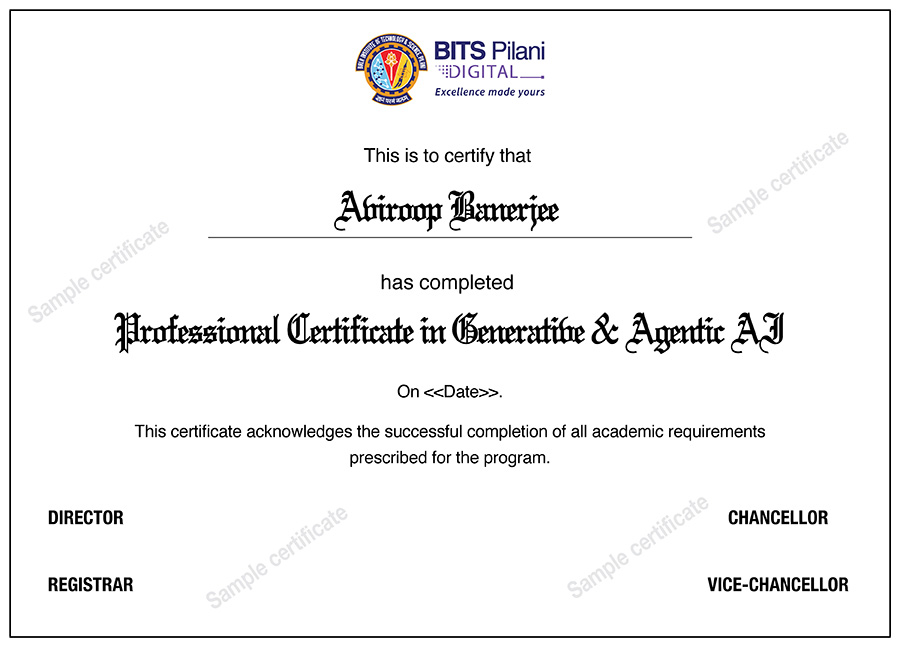
Sample certificate
Fee structure
Total program fee
INR 96,000 +GST
Includes booking fee of INR 12,000
(Non-refundable)
Interest free EMI
INR 16,520/month
(Six-month easy EMI)
Some labs may use shared, open-source, or free-tier environments. However, certain advanced modules may require learners to use AWS cloud services, including GPU compute, storage, virtual machines, and related cloud resources and tokens from providers like Open AI / Gemini / Anthropic. Any usage costs incurred for these services will be borne by the learners and is not included in the program fee. Usage & cost details
Build a stronger foundation in Python and AWS with our Bridge program at INR 16000+GST. Click here to learn more.
Booking fee
USD 185
(non-refundable)
Total program fee
USD 1490
(Includes booking fee)
Some labs may use shared, open-source, or free-tier environments. However, certain advanced modules may require learners to use AWS cloud services, including GPU compute, storage, virtual machines, and related cloud resources and tokens from providers like Open AI / Gemini / Anthropic. Any usage costs incurred for these services will be borne by the learners and is not included in the program fee. Usage & cost details
Build a stronger foundation in Python and AWS with our Bridge program at USD 209. Click here to learn more.

The most asked questions
It is a 30-week online certificate from BITS Pilani Digital that takes working technology professionals from using Gen AI and Agentic AI tools to building production-grade applications. You learn to design, build, evaluate and deploy applications powered by Large Language Models (LLMs), Retrieval-Augmented Generation (RAG), AI agents, and agentic workflows, the same stack that engineering teams at top product companies are hiring.
Generative AI is about creating content with models like LLMs, text, code, images, summaries. Agentic AI is the next step: AI systems that reason, plan, use tools, call APIs, and complete multi-step tasks on their own. Most short courses stop at Gen AI. We cover both because real-world enterprise problems are moving from “ChatGPT-style chat” to autonomous agents that actually do the work. You finish the program able to ship both.
At a high level, the curriculum is built around four pillars:
- Foundations of Generative AI and Large Language Models, how they work, prompting techniques, fine-tuning, and responsible-AI considerations.
- Retrieval-Augmented Generation (RAG), grounding LLMs in your own data with vector stores and embeddings.
- Agentic AI, designing autonomous agents, multi-agent orchestration, tool use, planning, memory and workflow automation.
- Production readiness, evaluation frameworks, observability, guardrails & security, cost and latency optimisation, and deployment patterns.
Every module is paired with hands-on lab demonstrations that are demonstrated alongside the theory.
The program is built around selective tool depth, not tool overload. You learn each tool in the context of where it fits in a production AI system, then build with it across the labs and capstone — so you walk out fluent in the stack, not just familiar with the logos.
The curriculum is organised around eight layers of the modern AI systems stack:
- Intelligence & reasoning — OpenAI (ChatGPT and GPT-class models) and/or Anthropic Claude and/or Google Gemini type will used as the reasoning engine behind your applications, structured outputs and intelligent workflows.
- Agent orchestration — LangGraph and/or LangChain type for designing single-agent and multi-agent workflows, including planning, tool use, memory and reflection patterns.
- Knowledge & retrieval — Qdrant like as the vector database, with embeddings, document chunking, retrieval and reranking pipelines, and citation grounding for production-grade RAG.
- Workflow automation — n8n for wiring AI into real business workflows with approvals, audit logs and exception handling
- Integration & protocols — Model Context Protocol (MCP), the emerging standard for how modern AI systems share context and access external tools.
- Action layer — Slack or other type and other team-communication integrations so your agents can send updates, trigger actions and operate inside real workflows.
- Evaluation & reliability — Pytest, Langfuse, type of custom evaluation harnesses, hallucination tests and regression testing — the engineering layer most short courses skip.
- AI application layer — Streamlit and Flask for turning your LLM, RAG and agent workflows into demoable, user-facing products.
Your development environment uses Python, Jupyter, VS Code with AI extensions, Git and GitHub, and Docker. Cloud deployment in the capstone runs on AWS.
A note on evolution: AI tools change fast. The curriculum is updated each cohort to reflect what is actually being adopted in industry, and the deeper skill we teach is how to evaluate, choose between and switch tools — so you stay relevant as the stack continues to evolve.
Yes, there are some additional costs. Many of the tools and frameworks you'll use in this program is free and open source: Python, Flask, React, Git & GitHub, Docker Desktop, VS Code, CrewAI, LangGraph, LangChain, Qdrant, n8n, and Langfuse. You will not pay for any of these.
Your real out-of-pocket spend is approximately ₹14,000–25,000 across the full 30 weeks, which works out to about ₹2,000–3,500 per month. This comes primarily from (but not limited to) LLM API costs, Claude Pro Subscription for program duration, AWS Cloud Costs), and any short term subscription fees.
Optional DIY Mode: Alongside the standard cohort project, you can simultaneously build the same system in a domain of your own choosing — your industry, your data, your use case. This is entirely optional, and if you opt in, expect your API spend to roughly double.
A few things to know:
* You manage all these subscriptions yourself, the Institute does not bill you for them, and you procure them directly.
* We cover account setup and budget configuration in detail during Week 1, so you start with limits already in place.
* You may need to subscribe to additional paid tools if deemed necessary during the program.
It is built for intermediate technical learners, typically engineers with minimum of 2 years of work experience, who already write code and now want to add Generative AI Application building to their toolkit. We start at the conceptual level for each topic, then quickly move to implementation. If you have never written Python, take the optional Python Bridge Course alongside the main program. If you are already a senior AI/ML engineer building LLM apps in production, the agentic, evaluation and orchestration modules will be the highest-value parts for you
Short courses teach you to use Gen AI as a user. This program teaches you to build applications using Generative AI, as an engineer would. You learn the architecture behind LLMs, how to ground them in your own data, how to wrap them in agents that perform reliable multi-step tasks, and how to evaluate, monitor and deploy these systems in production-like environments. The capstone, mentor reviews and 30-week depth mean you walk out with portfolio-grade work, not a slide-deck certificate.
The program is designed for working technology professionals, including:
- Software engineers and backend developers who want to add Gen AI & Agentic AI Application development capabilities to their stack.
- Data engineers, data scientists and AI/ML engineers moving from classical ML to Gen AI and agents.
- Solution architects, platform engineers and tech leads designing Gen AI capabilities for their teams.
- Technical product managers who need to ship Agentic AI features and want to speak the language of the engineers building them.
- Mid-career professionals Minimum 2 years of relevant work experience) looking to make a credible move into AI roles.
You need a bachelor’s degree in Science/Mathematics and working familiarity with code, ideally Python and AWS. Learners who need a Python and AWS refresh can enrol in the optional Python Bridge Course that runs alongside the main program.
Yes. If you don't currently meet the foundational proficiency requirements in Python and AWS, you can enrol in our optional 8-week Bridge Program. The program covers the fundamentals required for the Professional Certificate through self-paced learning during the week and live weekend classes.
To successfully complete the Bridge Program, you'll need to complete the prescribed learning content, quizzes, and maintain at least 75% attendance in the live sessions. Upon successful completion and submission of a self-assessment declaration, you'll be eligible for admission to the next available batch of the Professional Certificate in Generative & Agentic AI, subject to batch availability and the Institute's discretion.
It can be, if you are willing to code. The program assumes hands-on building, not just conceptual learning. If you are a product manager or analyst who wants to lead AI initiatives end to end, you will get enormous value, but expect to write code, demonstrated in the lab exercises and capstone. If your goal is purely strategic or non-technical, a business-focused AI program may suit you better.
Applications are submitted online at the program page. Admissions are based on academic background, professional experience and a short statement of purpose. There is no GATE / GMAT-style entrance exam. Once shortlisted, you complete enrolment and joining formalities, and you are added to your cohort and learner platform.
Note: Learners will be required to submit a self-assessment declaration confirming that they are adequately prepared to pursue the Professional Certificate in Generative & Agentic AI.
The program runs for 30 weeks. Plan for roughly 8–10 hours per week, a mix of self-paced learning, live sessions, exercise demonstration and a common Capstone project.
Yes, it is fully online and built around three layers: rich self-paced video, reading and labs exercises via lab demonstrations to build conceptual clarity before each live session; live online sessions led by either BITS Pilani Digital faculty and/or industry mentors focused on application, demos and live problem-solving demonstrations; and continuous mentorship across exercises with the help of Teaching Assistants and the capstone. You do not have to travel to campus.
Yes. Live sessions are scheduled at working-professional-friendly times, typically weekends and select evenings. All sessions are recorded and available on the learner platform, so if you miss one because of travel or work, you can catch up the same week. Mentor/Teaching Assistants office hours and discussion forums are available throughout the program for follow-up.
You can watch the recording at your convenience, post questions in the cohort forum. If you miss a live session, recorded content is available in the LMS. And in case of any technical questions related to the topics in the Live recording, a question can be posted in the Forum and a Teaching Assistant will reply to the same.
You will build incremental work on real-world like exercises that are demonstrated in the prerecorded sessions and/or Live Sessions in every module, LLM-powered applications, RAG systems grounded in your own selected document corpus, agentic workflows that automate multi-step tasks, evaluation harnesses, and a deployment-ready system in the capstone.
The capstone is the final, end-to-end project of the program. You work on a guided problem statement, designing and building an end-to-end Generative or Agentic AI solution to address it rigorously. It becomes the center piece of your portfolio when you interview for AI roles, a working system you designed, not just a notebook.
Yes. To receive the “Professional Certificate in Generative & Agentic AI” you must complete all quizzes and the capstone project with a minimum “fair” grade. This standard exists so that the certificate carries real signal to employers, every graduate has shipped a graded, reviewed system.
You receive the “Professional Certificate in Generative AI & Agentic AI” from BITS Pilani Digital. It is issued in your name on successful completion of all quizzes and the capstone at the required grade level. You can add it to LinkedIn, your résumé, and your professional profile.
BITS Pilani is one of India’s most established institutions and is widely recognised by Indian and global employers. The certificate carries the BITS Pilani Digital identity, and the curriculum is built around the skills hiring managers are actively screening for in 2026, LLMs, RAG, agents, evaluation and production deployment. The strongest signal you carry to interviews, however, is the portfolio of work you build during the program.
No, this is a non-degree, non-credit professional certificate program, not a Bachelor’s or Master’s degree. It is designed for skilling and career acceleration, not academic credit transfer. If you are looking for a degree, BITS Pilani Digital offers separate UGC-approved online degree programs you can explore.
The total program fee is ₹96,000 + applicable GST. This includes a non-refundable booking fee of ₹12,000. The fee covers 30 weeks of structured learning, all live sessions with BITS Pilani Digital faculty and/or instructors, industry, instructors, the self-paced content library, infrastructure, capstone mentorship and review, and the final certificate of completion. The Bridge Program is billed separately at ₹16,000 +GST.
Yes. EMI and no-cost EMI options are available through our financing partners so you can spread the fee over 6 months. You can review the available plans on the application page or speak to an admissions counsellor for the option that fits your situation.
You have a 7-day refund window from the date of your first class. If you decide within those 7 days that the program is not right for you, you can request a refund by writing to the admissions team, note that the ₹12,000 booking fee is non-refundable, so the refund applies to the balance of the program fee. After this 7-day window, the fee is non-refundable.
Graduates typically position themselves for roles such as:
- AI Engineer / Generative AI Engineer
- LLM Application Developer
- Agentic AI Engineer / Agent Developer
- Technical Product Manager, AI Products
The exact role you target depends on your existing experience and the seniority of your current title. The program is designed to make you credibly hireable for an AI-engineering line of work, not just “aware” of Gen AI.
Knowing AI isn’t enough. You need the direction and confidence to put it to work in your career. That’s where our Career Services framework steps in which provides.
- Learn from industry experts: Gain insights from industry professionals who help you align your skills with real-world expectations.
- Curated Career Enablement: Access to opportunities through the BITS Pilani Digital’s career services ecosystem.
Disclaimer:
BITS Pilani Digital equips learners with industry-relevant skills and career support to enhance employability. However, job placement or advancement is not guaranteed. Opportunities depend on market conditions, learner performance, and individual goals. Learners are expected to take ownership of their career growth and actively apply what they learn.
Three things set this program apart:
- Depth, not just breadth, 30 weeks built around production-grade like Generative and Agentic AI, not a 6 to 12-week tour of slides
- Faculty and/or industry practitioners, every cohort blends BITS Pilani Digital faculty and industry instructors actively building these systems,
- Portfolio-grade capstone, you graduate with a deployed, reviewed system you can demo in interviews, not a course-completion badge.
Combined with the BITS Pilani institutional name, this is what changes how hiring managers read your résumé after the program.
You can absolutely self-teach Gen AI, the materials exist online for free. What you cannot replicate alone are the structure that gets you to the finish line on a working professional’s schedule, insights from experts that turns a clever notebook into a production-like system, the cohort of peers you learn faster with, and the BITS Pilani Digital signal on your résumé that opens doors before the first interview. If you value time, accountability and a credible signal, a structured certificate compounds well.
A dedicated learner support team is available throughout the program for platform, scheduling and administrative queries. For learning questions, you have weekly live contact sessions of 2 hours with Industry instructor, and a cohort discussion forum. You are not learning alone.
If you are a working technology professional who is comfortable writing code, sees Gen AI engineering as the next 5-year direction of your career, and wants a credible certificate and portfolio without taking a career break, this program is built for you. The fastest way to be sure is to book a free counselling call from the program page, you can walk through your profile, your goals and the cohort timeline with an admissions counsellor before you commit.