

 +91 8423662366
 Apply Now


-

Program Fee
INR 1,25,000 (+ GST)
Easy EMI option
Exclusive program fee for limited seats
Batch start date
To be announced

Duration
~35 weeks

Type of program
Certificate
Program introduction
In today’s hyperconnected world, every application you build faces a growing wave of cyber threats. Yet, most cybersecurity efforts still focus on defense after the fact — patching vulnerabilities instead of preventing them.
The Professional Certificate in Cybersecurity and Secure Software Development, co-created by BITS Pilani Digital and leading industry practitioners, empowers developers to build secure systems that can withstand modern threats.
Lead the next wave of cyber defense
India’s cybersecurity market is projected to grow at over 20% CAGR, yet there’s a significant talent shortfall in secure software development.
As organizations accelerate digital transformation, the demand for professionals who can both develop software and secure it is soaring.
This program bridges that gap by training professionals to think like developers and act like defenders — mastering both the engineering mindset and the cybersecurity toolkit.
You’ll gain practical, project-based skills that are immediately applicable to roles in application security, cloud defense, data protection, and threat management.
(Source: Grand View Research)
The BITS edge
Learn deeper with BITS Pilani’s academic depth. Rise higher to lead the next wave of cybersecurity innovation.
Traditional cybersecurity programs teach professionals to react only after threats strike. And yet, security should not be bolted on—it should be built in.
Learn deeper,
rise higher
Learn how to write, test, and deploy secure code across modern frameworks and environments.
Understand common vulnerabilities, from injection attacks to insecure APIs, and apply secure development practices that prevent them.
Develop the mindset to build software that’s not just functional — but inherently safe.
Traditional certification-style training doesn’t create defenders. Experience does. Because you don’t learn to defend by reading about attacks. You learn by defeating them.
Learn deeper,
rise higher
Move beyond passive lectures to solve real-world cybersecurity problems. Each of the seven projects in the program focuses on a different class of cyber threat — from application-layer exploits to cloud and AI-driven vulnerabilities — helping you build hands-on mastery through discovery and resolution.
Security isn’t a patch. It’s a property of every layer. Yet most programs only touch the surface of secure coding by teaching isolated principles or focusing on a single layer of application security.
Learn deeper,
rise higher
Gain a 360° view of cybersecurity across the entire technology stack — data, application, and infrastructure.
From cryptography and secure coding to container security and AI-based threat detection, you’ll learn to secure every layer of software development and deployment.
By the end of the program, you’ll be able to design, build, and protect applications from the ground up.
In cybersecurity, experience matters most. But real defense needs a safe environment to practice.
Learn deeper,
rise higher
Work hands-on in a safe, virtual environment built to simulate real cyberattack and defense scenarios.
Here, you can experiment with tools, study threats, and test your countermeasures without endangering your own systems.
This clean-room environment ensures practical, risk-free learning — allowing you to truly experience what it means to defend digital systems in real time.
In the world of secure software, passing tests doesn’t prove mastery. Solving real problems does.
Learn deeper,
rise higher
No exams. No rote tests.Your progress is measured through seven real-world cybersecurity projects, each focused on solving a practical problem.
These projects not only solidify your learning but also build a tangible portfolio of evidence — demonstrating your skills, problem-solving approach, and readiness for industry roles.
Most cybersecurity programs focus either on theory alone or purely practical workshops.
Learn deeper,
rise higher
Learn under the combined mentorship of professors and senior industry practitioners.
This dual approach blends academic rigor with professional insight — giving you conceptual depth, technical expertise, and an understanding of what organizations really look for in cybersecurity professionals.
Every live session and project is guided by experts who’ve built, broken, and secured systems at scale.
No learner should walk alone. Growth happens with the right balance of independence and guidance.
Learn deeper,
rise higher
The program ensures industry readiness through mentorship, visibility, and confidence-building.
You’ll receive:
- Career Mentorship: Guidance from experts on presenting your projects and professional profile.
- Partner Network Access: Curated opportunities through BITS Pilani’s extended ecosystem.
- Interview Navigation: Support in understanding selection processes and technical evaluation.
Disclaimer:
BITS Pilani Digital equips learners with industry-relevant skills and career support to enhance employability. However, job placement or advancement is not guaranteed. Opportunities depend on market conditions, learner performance, and individual goals. Learners are expected to take ownership of their career growth and actively apply what they learn.
Eligibility criteria
If you’re ready to move from building applications to protecting them, this program will help you make that leap.

Applicants either pursuing or have completed a recognized graduate degree (in any discipline).

Applicants are expected to have basic proficiency in Python. While any graduate meeting the eligibility criteria can apply, those with little or no prior exposure to programming may find some courses challenging.
To support such learners, BITS Pilani Digital offers a 4-month Python preparedness program focused on building essential computational and coding skills required for success in the Cybersecurity & Secure Software Development program.
Eligible applicants can either join directly or first complete the Python preparedness program before enrolling in the Cybersecurity & Secure Software Development.
Important
Offer of admission would be based only on BITS Pilani Digital Admission Cell’s assessment of the overall application, and meeting the eligibility criteria does not guarantee selection or admission.
Learning methodology
This program uses problem-based learning, an approach proven to build deep, applied understanding. Each week introduces a new threat scenario, which you’ll tackle using specific frameworks, tools, and defense strategies — supported by guided mentorship and peer collaboration.

Problem-first approach
Learn cybersecurity the way it’s practiced — by solving real-world threats from day one. Every module begins with a problem, not a lecture, helping you think, debug, and defend like a security engineer.

Structured weekly learning routine
- ~3+ learning hours of recorded video content
- ~6 hours of hands-on projects/labs
- 2 hour of live instructor-led session for deeper insights and discussions
Expect around 9-10 hours per week of total learning engagement, optimized for technology professionals who can pursue this program along with their jobs.

Weekly live faculty interactions
Once a week, learners join live sessions led by BITS Faculty and industry mentors for deeper explanations, demonstrations, and live problem-solving. These sessions help bridge the gap between learning and execution, ensuring clarity and confidence as you progress.

Continuous support from TA mentors
Learning continues beyond the classroom. Dedicated TA mentors actively engage with learners through discussion forums, providing on-demand guidance, technical feedback, and clarifications, so that you’re supported every step of the way.
This is not passive learning — it’s structured problem-solving that mirrors real cybersecurity workflows.
Master 25+ industry-grade tools














Disclaimer:
The tools, software platforms, and technologies referenced in this course are subject to change. Individual instructors may choose to incorporate alternative or additional tools based on their teaching approach, availability of resources, and evolving industry standards. As a result, learners may experience variations in the tools used across different sessions or by different instructors.
Tech creator voices

On the importance of building secure software.
In conversation with Gaurav Ghai

The Rising Demand for Cybersecurity Problem-Solvers
In conversation with Nilesh

This isn't just learning, it's practical, applied training
In Conversation with Shivangi

Stay relevant as cybersecurity reshapes tech
In conversation with Vishnu

Take your first step toward secure software development
In conversation with Yashashvi
Turn the cybersecurity boom into your breakthrough.
That’s how many cybersecurity experts India needs. Only half the demand is met. (Source: NASSCOM)

Of skill gap in roles requiring application and software security expertise.

Increase in cybersecurity-related job postings since 2019. (Source: Indeed)

Where opportunity meetsoutcomes

Secure systems. And your place at the top.
Tools built into
the curriculum

That’s how much more cybersecurity pays compared to traditional IT roles. (Source: Quess Corp)

Is all it takes to transform into a cybersecurity and AI leader.

Job roles in the industry
The deeper you learn to defend, the higher your career ascends.
Role | Earning Potential* | What You’ll Do |
| Cybersecurity Analyst | ₹ 5-8 LPA | Monitor security systems, analyze threats |
| SOC Analyst | ₹ 5-8 LPA | Security monitoring, incident triage |
| Junior Penetration Tester | ₹ 6-10 LPA | Vulnerability assessment, security testing |
| Application Security Engineer | ₹ 7-12 LPA | Secure code review, DevSecOps |
*Source: 6figr, Indeed, SOC Masters, GeeksforGeeks, Sharpener
Role | Earning Potential* | What You’ll Do |
| Security Engineer | ₹ 8-15 LPA | Security architecture, system hardening |
| Incident Response Specialist | ₹ 10-18 LPA | Breach investigation, forensics |
| Cloud Security Engineer | ₹ 10-16 LPA | Multi-cloud security implementation |
| Cybersecurity Consultant | ₹ 12-20 LPA | Risk assessment, compliance auditing |
*Source: 6figr, Indeed, SOC Masters, GeeksforGeeks, Sharpener
Role | Earning Potential* | What You’ll Do |
| Security Architect | ₹ 15-30 LPA | Enterprise security strategy, design |
| CISO/Security Manager | ₹ 25-50 LPA | Security program leadership |
| Principal Security Engineer | ₹ 20-35 LPA | Advanced threat research, innovation |
| Cybersecurity Entrepreneur | Unlimited potential | Security product/service ventures |
*Source: 6figr, Indeed, SOC Masters, GeeksforGeeks, Sharpener
*Source: 6figr, Indeed, SOC Masters, GeeksforGeeks, Sharpener
This information is based on publicly available sources, and individual experiences may vary depending on multiple factors.
Curriculum Snapshot
Understanding the Digital Threat Landscape
This module introduces the foundations of cybersecurity, key terminologies, industry threats, and best practices. It covers the CIA triad, cybersecurity domains, roles, and standards, while also providing real-world industry applications. Learners gain exposure to recent incidents and hands-on activities like firewall configuration and phishing simulations.
Mapping Vulnerabilities and Attack Pathways
This module introduces learners to the principles of threat modelling, multi-step attack models, malware lifecycle, security testing, and incident response. It emphasizes early identification of threats in the development lifecycle, frameworks like STRIDE, ATT&CK, and NIST guidelines, and explores real-world case studies such as Log4j, Equifax breach, and WannaCry. Learners will engage in simulations, malware analysis, and hands-on incident response exercises.
Safeguarding Data and Communications
It covers classical and modern encryption techniques (AES, RSA, ChaCha, Diffie-Hellman), hashing and message authentication, as well as authentication, digital signatures, and non-repudiation. The module further explores network security protocols (TLS/SSL, IPSec), access control models, logging and monitoring, and the principles of zero-trust architecture.
This module focuses on secure engineering principles, secure coding practices, and the use of industry frameworks like OWASP to build resilient applications. It explores common vulnerabilities (SQL injection, buffer overflows, XSS, CSRF, insecure deserialization), language-specific coding issues, and security testing techniques (overview of SAST, DAST, penetration testing). Learners will gain practical exposure to security testing tools, vulnerable applications, and the role of GenAI in secure coding.
This module provides an understanding of how to secure data across stages, from creation and storage to transmission. Learners will explore the concept of data security and their threats, risks and the key data security concepts such as encryption, access control, authentication, and data classification. It introduces the industry best practices, and common security standards that guide organizations in safeguarding sensitive information. It provides exposure to widely used tools (such as encryption software, data loss prevention systems, and secure file transfer mechanisms) that will help the learners with hands-on insights.
Tools, Techniques, and Trends
This module introduces learners to the core principles of AI, ML in cybersecurity, it teaches how intelligent algorithms can identify, classify, and respond to digital threats. Learners will gain hands-on experience with open-source ML frameworks, learn to design models for malware and phishing detection, and understand how AI supports proactive threat hunting and automated defense strategies.
This module focuses on strengthening security within cloud environments across IaaS, PaaS, and SaaS models. Learners will explore common challenges such as service misconfigurations, risks in shared responsibility, and compliance gaps.
Emphasis will be placed on hardening cloud infrastructure by implementing network segmentation, encryption, and resource isolation, alongside securing containerized and serverless applications as well as cloud storage buckets. To improve visibility and control, the module highlights the importance of logging, monitoring, and automated compliance tools such as AWS Config, AWS Inspector, Terraform, and CSPM platforms. It also covers detection and mitigation of threats like DDoS attacks, using advanced anomaly detection tools (e.g., AWS GuardDuty).
Finally, learners will gain hands-on experience in security provisioning, configuration, and automation using scripting and tools like Python, Ansible, and Terraform to enforce consistent security practices.
Dual mentorship model - BITS Faculty & Industry Experts

Sreekanth Iyer
Expertise: Cloud Security Software Architecture AI/ML Integration
- Lead Software Architect & Director
- Ex-IBM (22 yrs) & Ex-Apptio (Cloudability) Principal Architect
- IBM Master Inventor with 60+ patents in cloud and app security
- Author of Hybrid Cloud Security Patterns
- Architected global solutions in Cloud Security, Banking, and Energy

Subhro Banerjee
Expertise: Cybersecurity Strategy Risk Management Compliance
- NextCSO 2024 Awardee & top cybersecurity leader
- Ex-PwC, ex-TCS, and ex-Airtel, with 20+ years’ experience securing global enterprises
- Certified C-CISO, CISM, ISO 27001 LA/LI
- Led programs aligned with ISO, NIST, PCI DSS, GDPR, HIPAA
- Advisor to CXOs on risk, GRC, and digital trust
- Strengthened SOC maturity and cyber resilience worldwide

Prof. Hemant Rathore
Expertise: Malware Analysis and Detection | Adversarial Robustness | Explainability
- 13+ years industrial & teaching experience
- Publications in top-tier conferences and journals
- Four Best Paper Awards and Best PhD Thesis Award
- Current research funding of INR 1cr+

Prof. Rajesh Kumar
Expertise: Cyber Risk Management | Predictive Analytics | Stochastic Model Checking
- PhD (Computer Science), University of Twente, Netherlands & MS (Communication Networks), Sant Anna School of Advanced Studies, Pisa, Italy
- 12+ years of work experience in diverse domains, including BITS - Pilani, Schneider Electric & Croon, Wolter & Dros
- Published more than twenty-five research papers on cyber-risk management in reputed journals & conferences with a cumulative IF>20
Note: The program is designed with inputs from academic and industry experts; however, the experts involved in its design may not necessarily participate in course delivery.
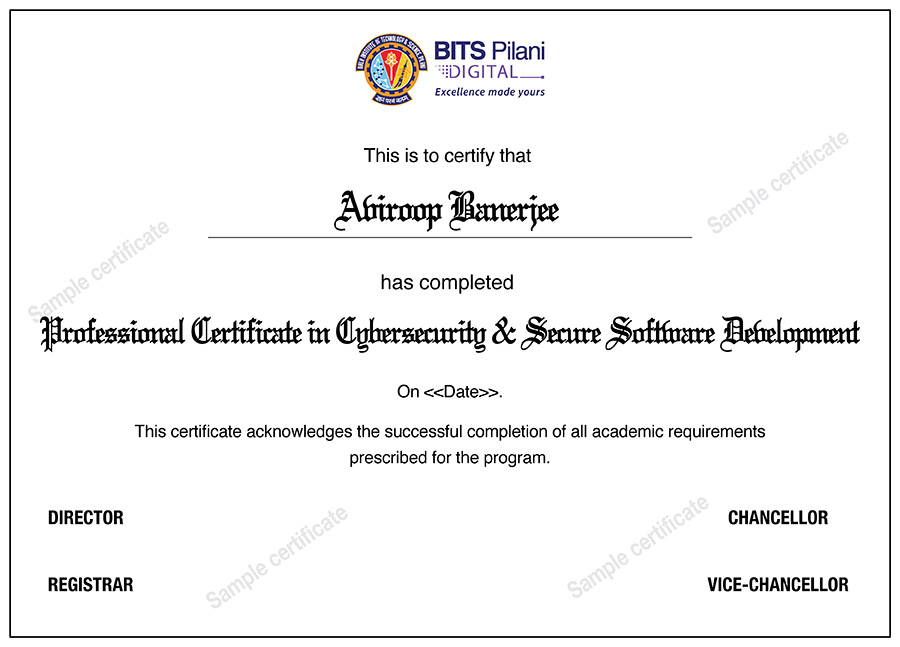
Sample certificate
Fee structure
Application fees
(to be paid on receiving the offer)
INR 1,500
(inclusive of GST)
Total program fee
(includes admission fee of INR 12,500)
INR 1,25,000 (+ GST)
Exclusive program fee for limited seats
While many labs use shared or open-source environments,
some advanced modules require enterprise cloud access. The associated usage costs are learner-funded.

The most asked questions
BITS Pilani Digital is the Digital Learning Division of BITS Pilani, one of India’s most respected and future-driven institutions. It offers a range of rigorous, industry-aligned upskilling programs for technology professionals who want to stay at the forefront of innovation and continuously grow with the evolving digital world.
By combining BITS Pilani’s academic excellence with hands-on, practice-oriented learning, BITS Pilani Digital enables professionals to strengthen their expertise, advance their careers, and stay future-ready,without stepping away from their current roles.
The Professional Certificate in Cybersecurity and Secure Software Development is built for technology professionals who want to design and defend secure applications, systems, and infrastructure through real-world problem-solving. It combines academic rigor with deep industry integration, enabling learners to gain practical mastery in secure coding, DevSecOps, cloud security, and AI-driven defense mechanisms.
Distinctive features of this program include:
- Layered Security Learning: Covers application, data, cloud, and runtime layers through simulated attacks and defenses.
- Clean Room Environment: Learn and practice in an isolated cybersecurity lab designed for real exploit-and-defend simulations.
- Problem-Based Learning (PBL): Engage in seven progressively challenging projects, each centered on a real-world cyber threat scenario.
- Dual Mentorship Model: Learn from BITS Faculty and industry professionals who actively secure enterprise-grade systems.
- Hands-on, Project-Based Evaluation: Every module integrates real-world projects and labs, and learners are assessed entirely on demonstrated skills,evaluated by what they build, secure, and deploy rather than through traditional exams.
This program is designed for technology professionals who want to build practical, end-to-end expertise in cybersecurity and secure software development.
It is ideally suited for:
- Software Developers, Full Stack Engineers, and DevOps Engineers looking to strengthen their security expertise.
- Technical Infrastructure or Security Engineers aiming to deepen their application-security and secure-coding capabilities.
- Professionals aspiring for roles such as Secure Software Engineer, DevSecOps Engineer, or Cloud Security Specialist.
While the program assumes basic familiarity with programming or scripting (e.g., Python, JavaScript, or Shell), all concepts are introduced progressively through guided projects and mentorship.
Applicants are expected to have basic proficiency in Python. While any graduate meeting the eligibility criteria can apply, those with little or no prior exposure to programming may find some courses challenging.
To support such learners, BITS Pilani Digital offers a 4-month Python Preparedness Programme focused on building essential computational and coding skills required for success in the Cybersecurity & Secure Software Development program.
Eligible applicants can either join directly or first complete the Python Preparedness Programme before enrolling in the Cybersecurity & Secure Software Development.
Yes. Applicants should have a basic understanding of programming or scripting (such as Python, Java, or C++) and professional experience in software development or IT infrastructure management.
While the program introduces cybersecurity concepts from the ground up, it’s designed for professionals who already understand technical workflows and want to apply them in real-world security contexts.
The program runs for approximately 35 weeks (about 8.5 months).
It comprises 7 problem-based learning modules, each focused on a unique cybersecurity threat class, progressing from application-layer exploits to cloud and AI-driven vulnerabilities.
Weekly learning structure:
- ~3+ hours of recorded digital learning modules
- ~6 hours of hands-on labs and project work
- ~2 hour of live mentor-led sessions for insights and discussions
Expect around 9–10 hours of total engagement per week, optimized for working professionals balancing their jobs with advanced learning.
The program provides exposure to over 20 industry-relevant tools, including: OWASP ZAP, Burp Suite, Metasploit, Wireshark, Terraform, GuardDuty, Splunk, Docker, Kubernetes, Jenkins, SonarQube, and Trivy, among others , all used for building, testing, and securing modern applications and infrastructure.
Yes. The entire program follows a Problem-Based Learning (PBL) approach.
You will solve seven progressively challenging projects, each modeled on a real-world cybersecurity scenario; such as mitigating injection attacks, securing APIs, preventing supply chain exploits, and safeguarding cloud workloads.
Every project is performed within a Clean Room Environment, ensuring safe, controlled, and realistic practice in detecting, exploiting, and defending against vulnerabilities.
Yes. While the program’s core focus is on secure software development, DevSecOps integration, and layered defense, it also familiarizes learners with modern and evolving threat landscapes.
You’ll explore how AI-assisted attacks, supply chain exploits, and cloud-native vulnerabilities are changing cybersecurity practices and how to build resilient defenses against them.
This ensures that professionals graduate with the awareness and adaptability required to safeguard next-generation digital systems.
Learning at BITS Pilani Digital blends academic rigor with expert-led, industry-driven engagement. The program is 100% online and follows a flipped classroom model, integrating self-paced digital learning modules with live weekend sessions, interactive discussions, and continuous mentor engagement.
Delivery is anchored in a dual mentorship model, featuring BITS faculty and industry experts, supported by hands-on labs in secure, cloud-based environments using real-world tools and workflows.
Active discussion forums ensure ongoing guidance, while the Problem-Based Learning (PBL) approach makes learning immersive, applied, and outcome-oriented.
The Clean Room Environment is a secure, sandboxed lab setup where learners can safely simulate, test, and defend against real-world cyberattacks without any external risk. It replicates production-grade infrastructure, allowing hands-on experience with exploits, vulnerabilities, and remediation ; just like professionals operate in enterprise environments.
This immersive setup bridges the gap between theory and practice, building true readiness for real-world cybersecurity challenges.
Programs at BITS Pilani Digital are taught by a distinguished pool of experts from both academia and industry. Faculty members may include:
- Professors from BITS Pilani’s campuses, bringing deep academic rigor and research-driven insight.
- Dedicated faculty from the Digital Learning Division, focused on delivering engaging, practice-oriented learning experiences.
- Guest faculty and mentors are carefully selected and rigorously onboarded from the industry and other prestigious academic institutions, ensuring that every course is current, applied, and industry-relevant.
In this program, learners benefit from a blend of academia-driven scholars and active industry practitioners — experts who build, secure, and defend real systems every day.
Experiential learning is at the core of this program.
All labs are mandatory and project-based, enabling learners to apply cybersecurity concepts directly to realistic attack and defense scenarios within a Clean Room Environment.
Through the Problem-Based Learning (PBL) model, you’ll simulate, analyze, and mitigate diverse classes of cyber threats using industry-grade tools and cloud environments, guided by faculty and industry mentors.
This hands-on approach ensures you don’t just study cybersecurity, you practice it, defend it, and master it.
There are no traditional exams. Evaluation is entirely project- and performance-based, aligned to the Problem-Based Learning (PBL) model.
Each of the seven projects is assessed for:
- Accuracy and depth of threat analysis
- Effectiveness of defense and remediation strategies
- Application of secure coding practices and automation
- Quality of documentation, explainability, and compliance alignment
- Learners are graded on performance bands for all the projects:
Excellent / Very Good / Good / Fair / Poor. - A minimum performance level of “Fair” is required in all modules for successful completion.
The guiding philosophy is simple , you’re evaluated on what you secure, not what you memorize.
Yes. The program is designed for working technology professionals and follows a flexible, part-time schedule.
Each week includes:
- ~3+ hours of expert-led digital learning modules
- ~6 hours of hands-on labs and projects
- ~2 hour of live instructor-led sessions for deeper insights
Expect 9–10 hours per week of total learning engagement, carefully structured so professionals can learn without taking a career break.
Yes. A single break is permitted, allowing you to move to the next available cohort at no additional cost, subject to seat availability and institute discretion.
Continuity is encouraged for maximum learning retention, given the program’s progressive structure.
This program prepares professionals for security-focused technical roles, such as Secure Software Engineer, DevSecOps Engineer, Cloud Security Specialist, Application Security Engineer, or Security Analyst.
Beyond technical roles, it also equips learners to embed security into development and infrastructure workflows, a highly valued skill in product and platform teams across industries.
The primary focus of BITS Pilani Digital is to make every learner industry-ready through a combination of rigorous, industry-aligned curriculum, hands-on projects, and mentorship from experienced professionals and faculty. This learning methodology is designed to build deep, career-relevant skills that empower professionals to progress confidently in their chosen domain.
To complement this, BITS Pilani Digital offers career enablement support, including resume guidance, career mentorship, and curated opportunities from its industry partner network. These opportunities, however, are not guaranteed and depend on several factors such as market conditions, learner performance, and individual career aspirations.
Learners are encouraged to take ownership of their career journey, actively leverage the program’s learning experiences, and pursue roles aligned with their skills and goals.
Successful learners receive a Certificate of Completion titled: “Professional Certificate in Cybersecurity and Secure Software Development”, issued by BITS Pilani.
To earn the certificate, learners must complete all seven projects and mandatory labs, achieving at least a “Fair” grade in each evaluation.
The transcript lists the seven project modules completed, along with a summary of performance using non-letter grades.
Program fees include access to all learning modules, hands-on labs, mentorship sessions, and evaluation support.
Flexible payment options are available, and detailed fee information can be found on the BITS Pilani Digital Program page.
While many labs use shared or open-source environments, some advanced modules require enterprise cloud access. The associated usage costs are learner-funded.
Each tier bundles a set of typical cybersecurity tools & services: hosting infrastructure (cloud/VPS), endpoint protection, phishing simulation/training, basic logging/monitoring, and minimal network/email hygiene. Costs are rough estimates in Indian rupees (INR), based on typical Indian VPS pricing + global endpoint-security licensing norms, adjusted for scale. Some tools may require Light and others may require Medium or Heavy setup and the costs may vary accordingly.
Tier: Light / Minimal
minimal compliance, mostly awareness + basic security hygiene
15,000 - 20,000 INR
Tier: Medium / SME-grade
regular phishing-awareness campaigns, periodic vulnerability scans, basic logging/monitoring
20,000 - 30,000 INR
Tier: Heavy / Compliant
with compliance/regulation needs, frequent campaigns, audit trails, moderate traffic, better redundancy
30,000 - 40,000 INR