+91 8423662366
 Apply Now
How to Choose the Right AI Agents Development Course in 2026?
Last Updated: October, 2026
Link copied!
Most AI agent courses teach you how to call an API. Very few teach you what to do when the agent gets it wrong. The difference sounds small. It isn't. It decides whether you come out with a demo or a skill.
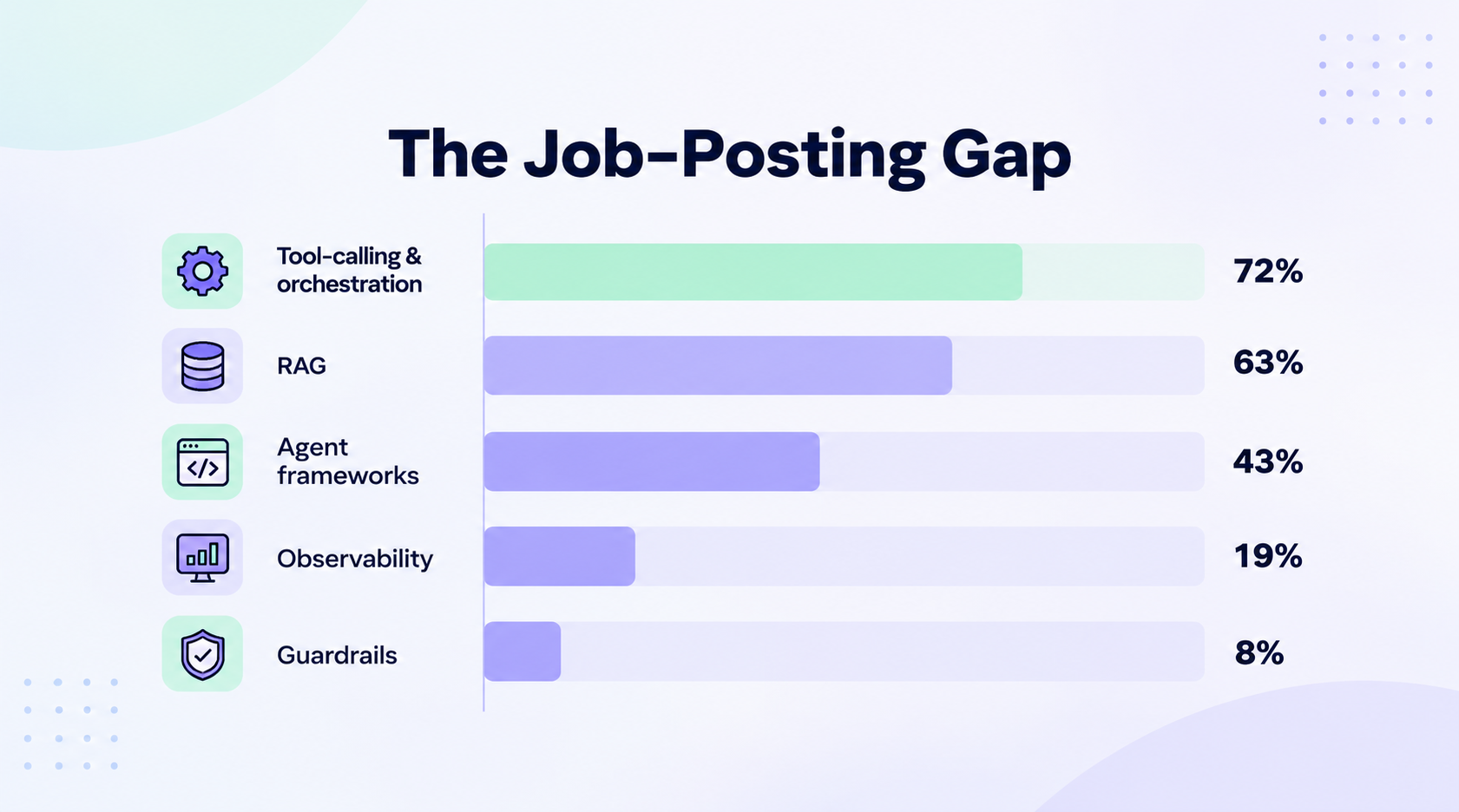
The market has noticed. A PTI-reported analysis of more than 28,000 Indian job postings found that 72% of agentic AI roles ask for tool-calling and orchestration, and 63% ask for RAG. Only 19% mention observability, and just 8% mention runtime safety and guardrails.
Read that the other way round. Almost everyone is learning to make agents act. Very few are learning to make them behave. If you're picking a course this year, that gap is your opportunity.
Here's how to tell the courses that close it from the ones that don't.
What Is an AI Agents Development Course?
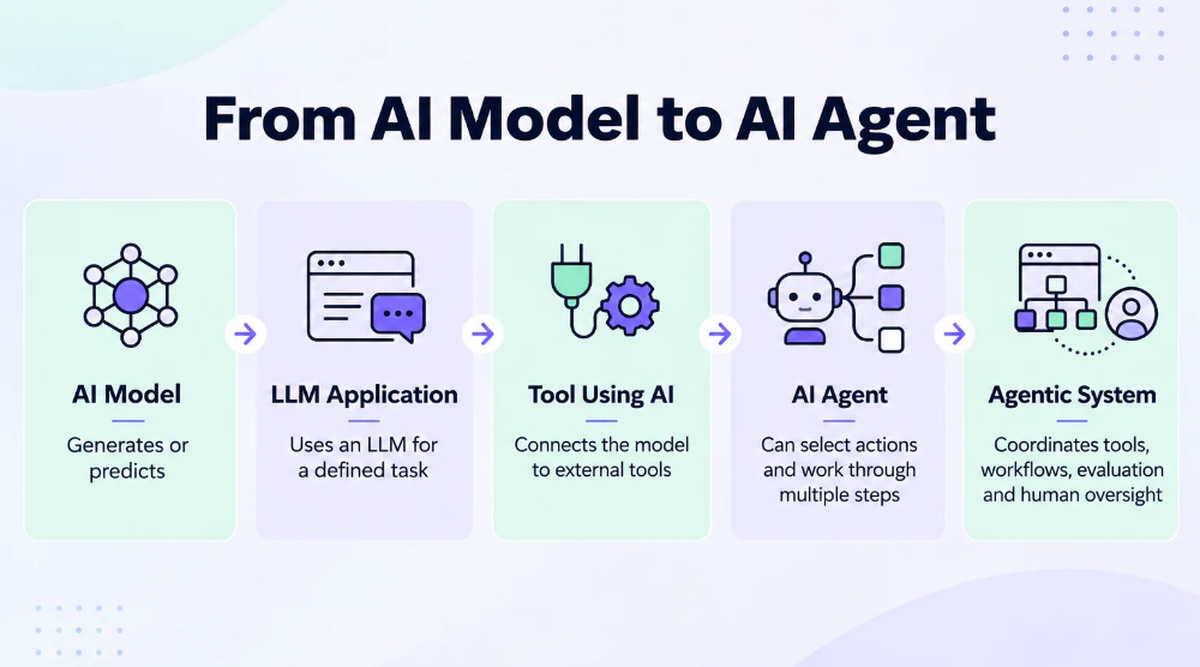
It's a course that teaches you to build AI systems that do more than reply. You give an agent a goal. It decides what to do next, pulls in data or calls a tool, checks the result and keeps going until the task is done, within limits you set.
A chatbot answers. An agent acts. Ask a chatbot about a delayed order and it explains your options. Ask an agent and it looks up the order, checks the courier's API, and drafts the refund for someone to approve.
One warning: "agent" has become a marketing word. Two courses can use it and mean very different things. Some mean a prompt with a tool attached. Others mean planning, memory, safeguards and testing. So skip the brochure headline and look at what is actually taught.
What Should You Learn in an AI Agents Development Course?
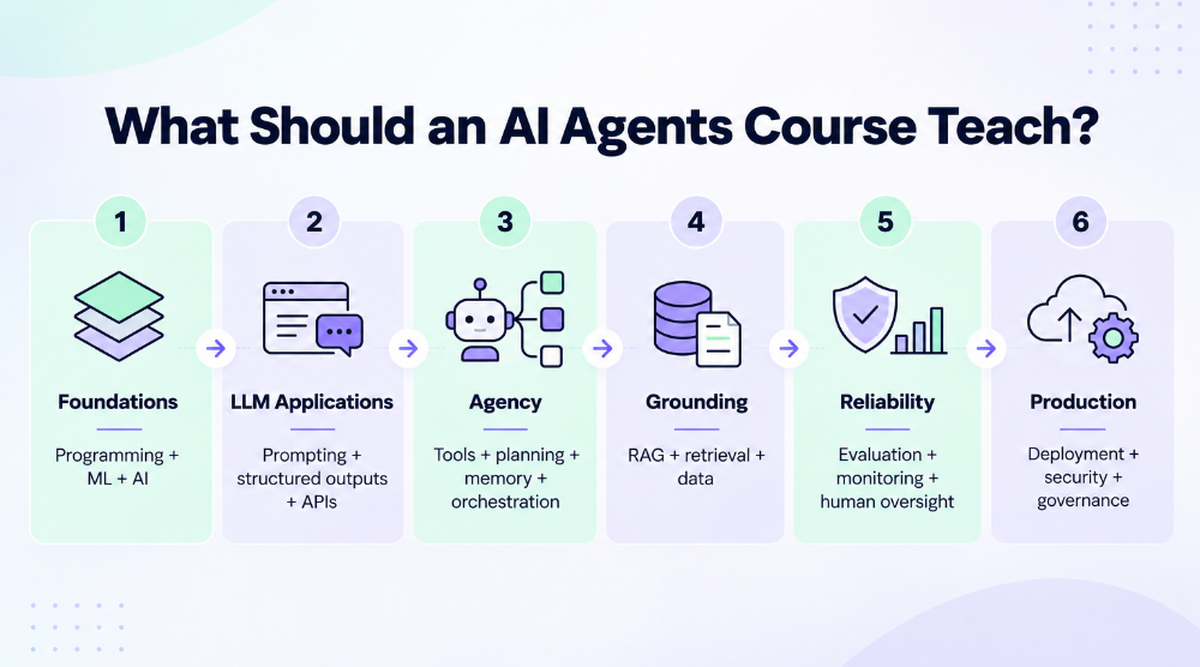
A good course builds up in six layers. If a layer is missing, you'll feel it later.
1. Foundations: Python, Cloud and How LLMs Work
You can't debug what you don't understand. Look for:
- Python, taught properly, not assumed
- Basic cloud skills: running code, managing keys, using hosted services
- Working with APIs
- How large language models work, and where they fail
If you come from Java, C++ or another language, a built-in foundation saves you from teaching yourself Python at midnight while trying to keep up.
2. LLM Application Development
This is where you start building with models. Prompt design, structured outputs (JSON you can actually parse), function calling, embeddings, managing context, and picking the right model for the job instead of the biggest one.
3. Agent Architecture
Now the course should move past single LLM calls. Agent workflows, planning, tool use, memory, orchestration and multi-agent systems. You should understand why an agent made a decision, not just that it made one.
4. Data and Grounding
An agent is only as good as what it knows. Look for retrieval-augmented generation (RAG), vector databases, chunking and retrieval quality, and connecting to real company data rather than a sample PDF.
5. Evaluation and Reliability
This is the layer most courses skip, and the one the job data above says is rare. A demo that works once is not a system. You should learn to test agent outputs, spot failure patterns, run regression tests when you change a prompt, and decide where a human needs to step in.
Academic thinking is heading the same way. A July 2026 paper, Educating the Agentic Engineer, argues that engineers working with autonomous systems need verification, oversight and governance skills, not just the ability to build.
6. Deployment and Responsible AI
Agents take actions. They send emails, update records, move money. So the course should cover deployment, monitoring, security, guardrails, cost and latency. A good test: ask the course provider how they teach you to stop an agent from doing something it shouldn't. If the answer is vague, so is the course.
A 7-Point Checklist Before You Enroll
Forget whether a course calls itself the "best AI certification course". Ask these instead:
- Does it teach foundations, or start straight with a framework?
- Will I build working agents myself, or mostly watch someone else do it?
- Does it cover RAG and connecting to real data?
- Will I learn to test and evaluate agent outputs?
- Are deployment, security and guardrails part of the syllabus?
- Who answers my questions when I'm stuck: faculty, mentors or a forum?
- Will I finish with something I can show an employer?
If the course page doesn't answer most of these, ask the admissions team directly. If they can't answer either, that tells you something.
What Kind of Projects Should an AI Agents Course Include?
"Hands-on" means nothing until you see the projects. A sensible course gets harder in steps.
Foundation project: a Q&A assistant that answers from a fixed set of documents, with citations, and says "I don't know" when the answer isn't there.
Intermediate project: an agent that picks between two or three tools to finish a task, for example checking a calendar, then booking a slot.
Advanced project: something close to what a company would actually run. Here's one example.
Example: An Invoice-Processing Agent
A mid-sized company's finance team handles 1,200 vendor invoices a month. Most are routine. A few have the wrong amount, a missing PO number or terms that don't match the contract. Those few cost real money.
An agent built for this would:
- Read the invoice. Pull the vendor, amount, dates and PO number out of a PDF into structured fields.
- Check it against the order. Call the ERP system to match the invoice with the purchase order and goods receipt.
- Check the contract. Use RAG to look up the vendor's payment terms and agreed rates.
- Flag or pass. Clean invoices go into the payment queue. Mismatches get a short note explaining what's wrong.
- Ask a human. Anything above ₹50,000, or from a new vendor, waits for a finance manager's approval.
- Measure itself. Track extraction accuracy on a test set of 200 invoices, false flags per week and cost per invoice.
Notice that half the steps are about checking, not doing. That's what a real agentic system looks like, and that's the kind of project worth putting on your CV.
BITS Insight: Where Does Agentic AI Fit Into the Learning Journey?
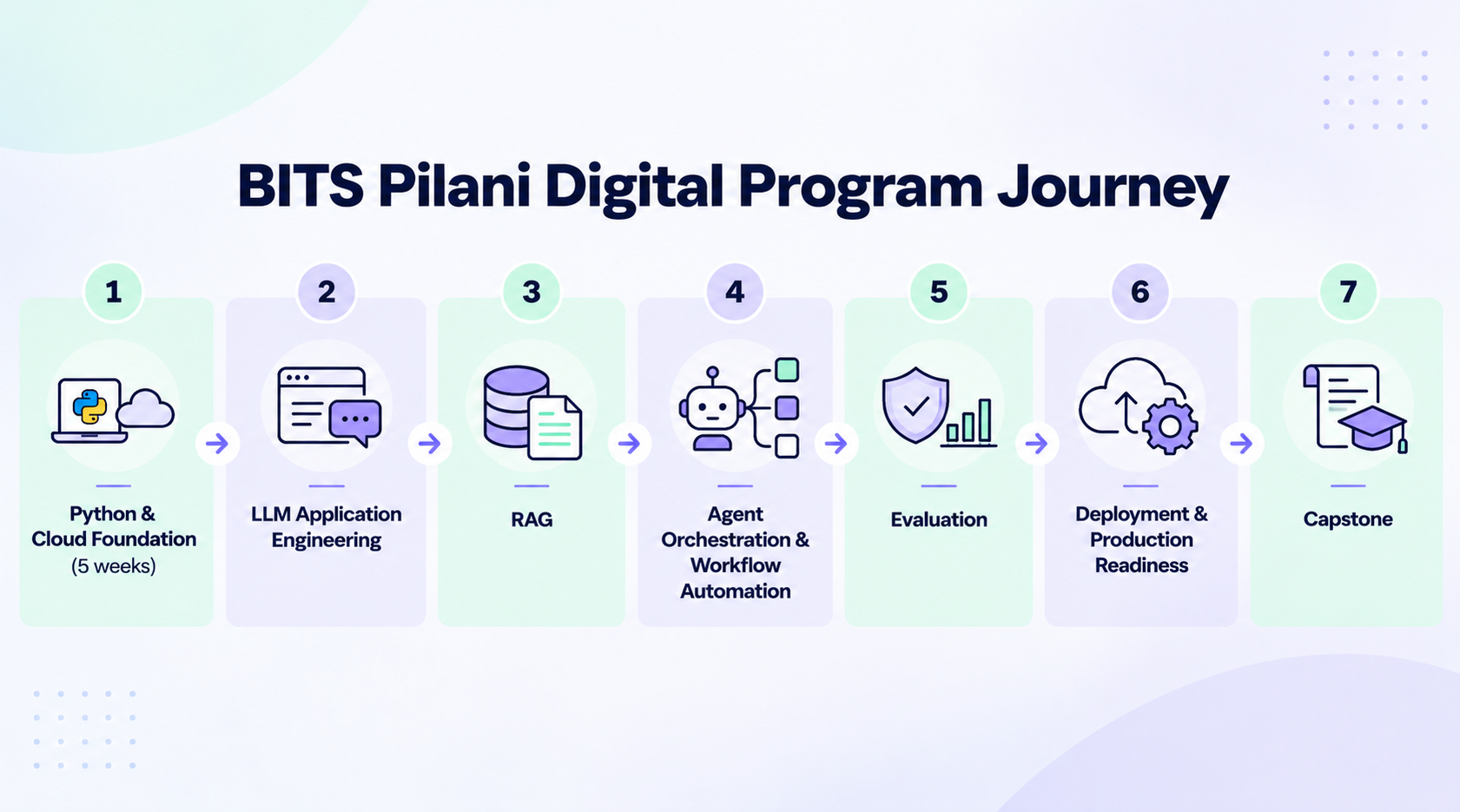
The Professional Certificate in Generative & Agentic AI from BITS Pilani Digital follows the same six-layer logic described above, with a build-first approach.
From the December 2026 cohort, the program runs as a single track of about 35 weeks. It starts with a five-week foundation in Python and cloud, then moves through LLM application engineering, RAG, agent orchestration, workflow automation, evaluation and production readiness. Every module has hands-on work, and it ends with a production-style capstone.
The point is to connect the pieces. You don't learn RAG in one box and agents in another. You learn how retrieval, tools, workflows and testing fit together in one system.
A few practical details if you work full time:
- Weekend classes: live sessions led by industry experts
- Fee: ₹96,000 + GST, with an interest-free EMI option over 6 months
- Duration: about 35 weeks, including the Python and cloud foundation
- Credential: a certificate from BITS Pilani Digital, plus a capstone you can show
Applications are open for the December 2026 cohort.
Who Is a Generative & Agentic AI Program For?
It suits you if you write code for a living, or want to, and are tired of only experimenting with AI tools. That includes software engineers, backend developers, data and ML engineers, solution architects and technical product managers.
It also suits recent graduates. You need a bachelor's degree and the ability to write basic programs in any language. Work experience helps, but it isn't mandatory.
No Python? That's fine. The first five weeks cover Python and cloud basics before you touch an LLM.
Build Agents That Actually Work
Anyone can get an agent to do something once. The people companies want can get it to do the right thing every time, and know what happens when it doesn't.
If that's the skill you want, start with a course that teaches all six layers and makes you prove it with a real project.
Key Takeaways
- Pick a course for what it teaches, not for how often it says "agent".
- Look for all six layers: foundations, LLM apps, agent architecture, data, evaluation and deployment.
- Evaluation and guardrails are where most courses are thin, and where job postings show the biggest gap.
- Projects should get harder, ending with a system that checks its own work and knows when to ask a human.
- A certificate opens the door. What you can build and explain gets you the job.
Frequently Asked Questions
A course that teaches you to build AI systems that work toward a goal on their own: choosing actions, using tools and data, and finishing multi-step tasks within limits you set.
Six things: programming and LLM foundations, agent architecture, RAG and data, evaluation, deployment with guardrails, and real projects. Check who supports you when you get stuck, too.
A chatbot replies to what you type. An agent takes steps: it looks things up, calls tools, checks results and carries a task through to the end.
You need to be able to write basic programs in any language. You don't need to know Python already if the course includes a Python foundation, as the BITS Pilani Digital program does.
Yes. A bachelor's degree and basic programming are enough to start. Work experience is preferred but not required, and the five-week foundation helps you catch up before the AI modules begin.
You can build a simple agent in a weekend. Building one that is reliable enough for real work usually takes several months of structured practice. The BITS Pilani Digital program runs for about 35 weeks.
Pick the course that makes you build, then judge the certificate. For more on when a certification pays off, read AI Agents Certification: Is It Worth It in 2026?

Share this article
Link copied!