+91 8423662366
 Apply Now
AI Agents Certification: Is It Worth It in 2026?
Last Updated: October, 2026
Link copied!
Everyone can use ChatGPT. Very few can ship an AI agent that works in production. That gap is where the next salary jump sits, and it's the only reason an AI agents certification is worth your time and money.
AI has moved past the chatbot stage. The new systems don’t just answer questions. They pull data, call tools, and finish multi-step tasks with little hand-holding.
Gartner expects up to 40% of enterprise apps to have task-specific AI agents built in by the end of 2026. In 2025 it was under 5%. Hiring is following the same curve. A September 2026 CIEL HR report found demand for agentic AI engineers in India grew 260% in a year, the fastest of any emerging tech role it tracked.
That shift creates a different professional requirement. Knowing how to use an AI tool is useful. Knowing how to design, build, evaluate, and deploy an AI system that uses agents is a deeper engineering capability.
Why Are AI Agent Skills Becoming More Valuable?
Demand is running ahead of supply, and by a wide margin.
TeamLease Digital’s Digital Skills & Salary Primer FY2026–27 puts India’s GenAI talent gap at about 53%. Demand for GenAI roles is expected to cross 10 lakh, but only around 3 lakh professionals have advanced AI skills. About 20 lakh have done some upskilling. Most of them stopped at the basics.
That gap shows up in pay. The same report puts a GenAI developer at ₹11.2 LPA with 0–2 years of experience and ₹34.5 LPA at 6–8 years. That’s roughly double what AI-support roles pay at the same level.
So the question isn’t whether to learn AI. It’s whether you stop at using it or learn to build with it.
What Does an AI Agents Professional Need to Know?
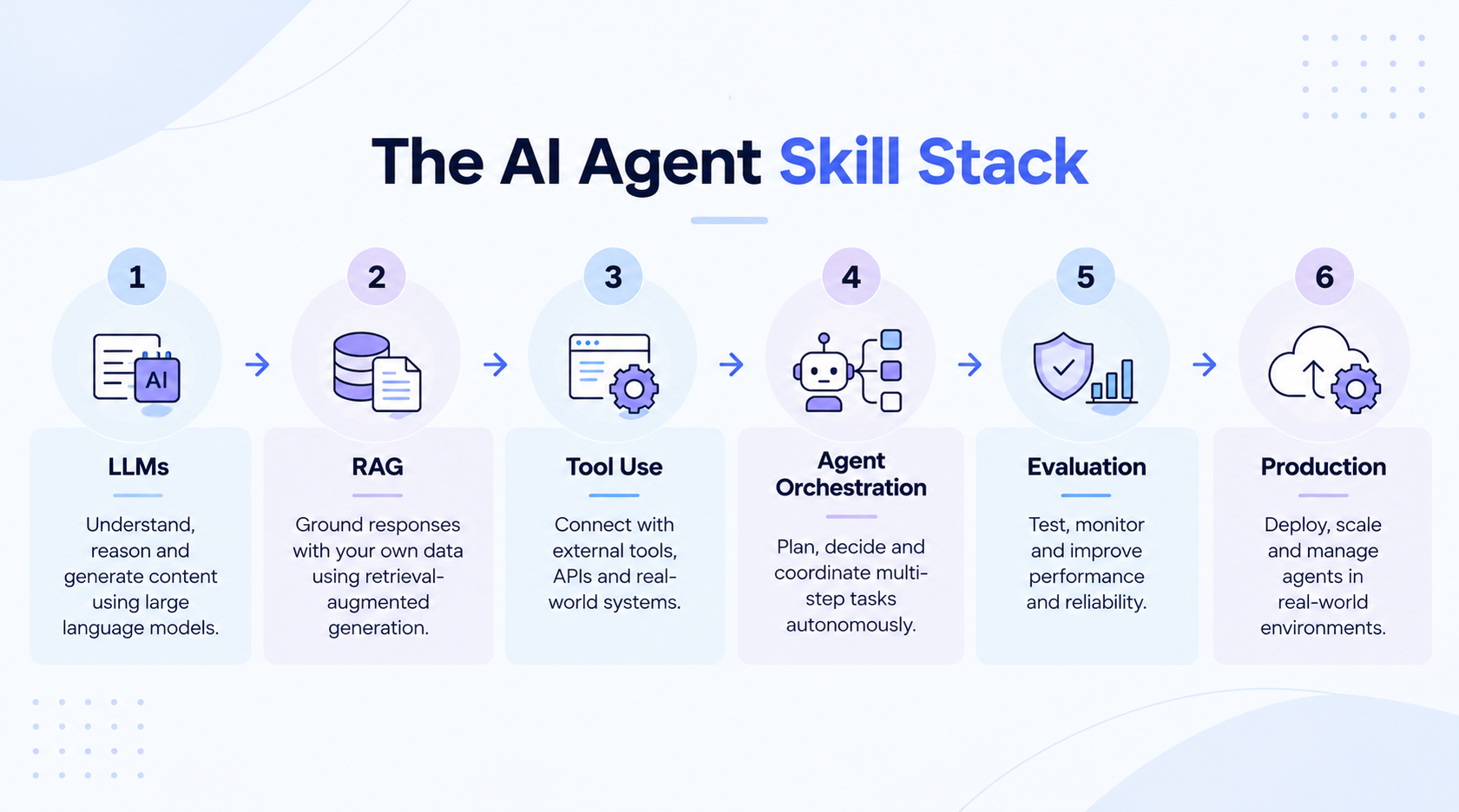
A useful way to evaluate an AI agents development course is to look beyond the word “agent” and check whether it develops these capabilities:
| Capability | What you should learn |
| LLM application development | Model selection, prompting, structured outputs and guardrails |
| RAG | Connecting models to trusted data through retrieval and embeddings |
| Agent orchestration | Planning, tool use, memory, task decomposition and multi-agent workflows |
| Integration | APIs, business tools, workflows and context sharing |
| Evaluation | Accuracy, hallucination checks, retrieval quality and regression testing |
| Production readiness | Security, observability, deployment, cost and reliability |
What Makes an AI Agents Development Course Worth Your Time?
Ignore the brochure. Ask one question first: what will I be able to build on my own by the last week? Then run the course through this checklist:
- Does it go past prompting into RAG, agents and production, in that order, instead of jumping straight into a framework?
- Will you build working applications in labs, or mostly watch demos?
- Does it teach you to test an AI system, find where it breaks and measure the fix?
- Are deployment, security, monitoring and cost part of the syllabus, not a bonus session?
- Is human review built into the workflows you design?
- Will you finish with a capstone you’d be happy to demo in an interview?
- Does it start where you are today, technically?
If you’re answering “no” to three or more, keep looking.
What Does This Look Like in Practice? A Support-Ticket Triage Agent
Checklists only go so far. Here’s the kind of system a good capstone should push you to build.
Picture a SaaS company that gets 3,000 support tickets a day. Half are repeat questions. Some come from customers who are one bad reply away from cancelling. A handful are real bugs that engineering needs to see today, not next week.
A triage agent takes the first pass:
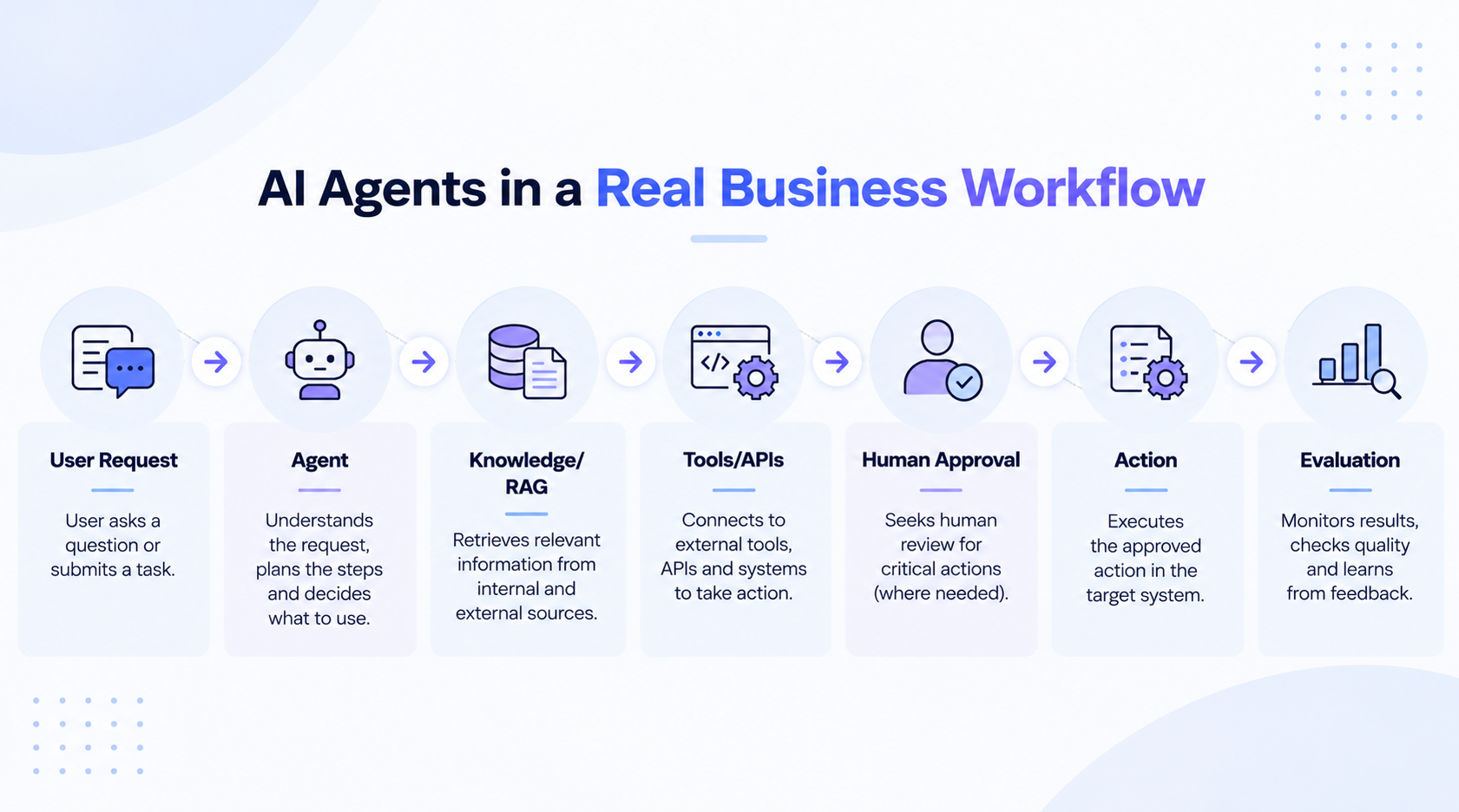
- Read and sort. The LLM reads each ticket and tags it by product area, urgency and mood. It returns clean JSON, not a paragraph of opinions.
- Look it up. Using RAG, it pulls the most relevant help articles and past resolved tickets from the company’s knowledge base.
- Check the facts. It calls the CRM to see the customer’s plan and history, and the bug tracker to see if someone has already logged the issue.
- Draft and route. Routine tickets get a draft reply. Bugs go to the right engineering queue with a two-line summary.
- Hand it to a human. Refund requests, legal threats and large accounts go to a support lead, who approves the reply before anything is sent.
- Keep score. Every week you check how often it mislabelled a ticket, how many drafts the team had to rewrite, and what each ticket costs in API calls.
You can get a rough version of this running in a weekend. Getting it to pass step six without embarrassing anyone is the hard part, and that’s the part employers pay for.
Is an AI Agents Certification Enough?
Not by itself.
A certificate can signal structured learning, but the stronger career advantage comes from the combination of knowledge, implementation experience and engineering judgement you develop through the program.
Here’s the uncomfortable part. Gartner predicts that over 40% of agentic AI projects will be scrapped by the end of 2027. The reasons it gives are rising costs, unclear business value and weak risk controls.
The problem there isn’t too few people who know what an agent is. It’s too few people who can make one reliable, affordable and safe in production. That’s why evaluation, guardrails and deployment matter more than another framework tutorial.
So, when comparing the best AI certification course options for your goals, ask what the program helps you do independently after completion.
BITS Insight: From Learning About Agents to Building Them
The Professional Certificate in Generative & Agentic AI from BITS Pilani Digital puts that weight behind a build-first program, where most of your time goes into building things rather than sitting through slides.
From the December 2026 cohort, the program follows a single-track structure of approximately 35 weeks, with a five-week foundation in Python and cloud built into the program. Learners then progress through LLM application engineering, RAG, agentic AI, evaluation, deployment and production readiness.
The program includes hands-on work across modules, followed by a production-style capstone and portfolio, with learning covering areas such as agent orchestration, multi-agent workflows, tool use, MCP, workflow automation, evaluation, observability, guardrails and deployment.
Agents aren't taught as a stand-alone topic here. You learn how the pieces fit together, from the model and retrieval to orchestration, actions and evaluation, because that's how they behave in a real system.
A few things that matter if you have a full-time job:
- Weekend classes: live sessions on weekends, led by industry experts, so you don’t have to take time off work
- Fee: ₹96,000 + GST, with an interest-free EMI option over 6 months
- Duration: about 35 weeks, including the Python and cloud foundation
- Credential: a certificate from BITS Pilani Digital, plus a capstone you can actually show
Applications are open for the December 2026 cohort. [ Check your eligibility → ]
Who Can Benefit Most From an AI Agents Certification?
A focused program can be particularly relevant if you work in technology, or are a technically qualified graduate, and want to:
- Add Generative & Agentic AI capabilities to your existing technical stack
- Build AI-enabled applications rather than simply use AI tools
- Move from classical software or ML work into GenAI systems
- Understand how agents connect with enterprise data and workflows
- Build practical evidence of AI system development
You do not necessarily need years of professional experience. The updated program requires a bachelor's degree and the ability to write basic programs in any programming language, while relevant work experience is preferred rather than mandatory.
No Python? That's covered. The first five weeks teach Python and cloud basics before you touch an LLM, so if you can write simple programs in Java, C++ or any other language, you have enough to start.
Build Your Agentic AI Advantage
The career value of agentic AI learning will not come from the certificate alone. It comes from what you can design, build, evaluate, and explain after completing it.
For technology professionals and technically qualified graduates, a structured, practice-led pathway can help turn growing interest in AI agents into a deeper technical capability.
Gartner also expects that by 2029, at least half of knowledge workers will be building, governing or working alongside AI agents. The people who learn to build these systems now will be the ones setting the standards later.
Key Takeaways
- AI agents are moving beyond experimentation into practical business workflows. That creates demand for deeper technical capabilities.
- A strong AI agents development course should cover LLMs, RAG, agent orchestration, tool use, evaluation, and production readiness.
- An AI agents certification is more valuable when it includes hands-on projects and real system building.
- For working professionals and technically qualified graduates, the right program should build on existing technical skills. It should help you apply AI to real software and business workflows.
- The strongest career advantage comes from being able to design, build, evaluate, and deploy AI systems, not simply knowing how to use AI tools.
Frequently Asked Questions
Yes, if it makes you build. A certification pays off when you finish with working projects, know how to test and deploy them, and can explain the trade-offs in an interview. Courses that stop at prompting rarely move your salary.
Look for LLM application development, RAG, agent orchestration, tool use, evaluation, workflow integration, deployment, security, and observability.
It is a structured learning program focused on designing and building AI systems that can use tools, retrieve information, coordinate tasks, and execute multi-step workflows.
For a practice-led technical program, programming experience is important because building and deploying AI systems involves coding, APIs, data, and application integration.
Not necessarily. Generative AI focuses broadly on technologies such as LLMs and AI applications. Agentic AI adds capabilities such as planning, tool use, orchestration, memory, and workflow execution.
It can help software engineers extend existing skills into LLM applications, RAG, agent workflows, evaluation, and production-oriented AI development.
Rather than relying on the word “best”, compare curriculum depth, practical work, evaluation methods, project quality, learning format, and how closely the program matches your existing skills and goals.

Share this article
Link copied!